
New Towns Mark One sets out in detail the origins of the new towns programme and provides the first detailed architectural survey of the ‘mark one’ new towns. Elain Harwood’s work offers a new account of British architecture in the years immediately after the Second World War which uses the new towns to explore what it meant to be architecturally modern between the 1940s and the 1970s.
Having worked for Historic England and its predecessor organisations for over forty years, Elain Harwood (1958–2023) was an immensely well-respected lecturer, tutor, tour guide, author and latterly, Senior Architectural Investigator. After Elain’s death in 2023, Alistair Fair was invited to come on board as editor of this book, using Elain’s manuscript as the basis of the present text, but with some key changes. Currently a Reader in Architectural History at the University of Edinburgh and a widely published specialist in the history of twentieth-century British architecture, Fair introduces the book in this blogpost, explaining the wider significance of the so-called ‘New Towns’ and the timeliness of the book’s publication.
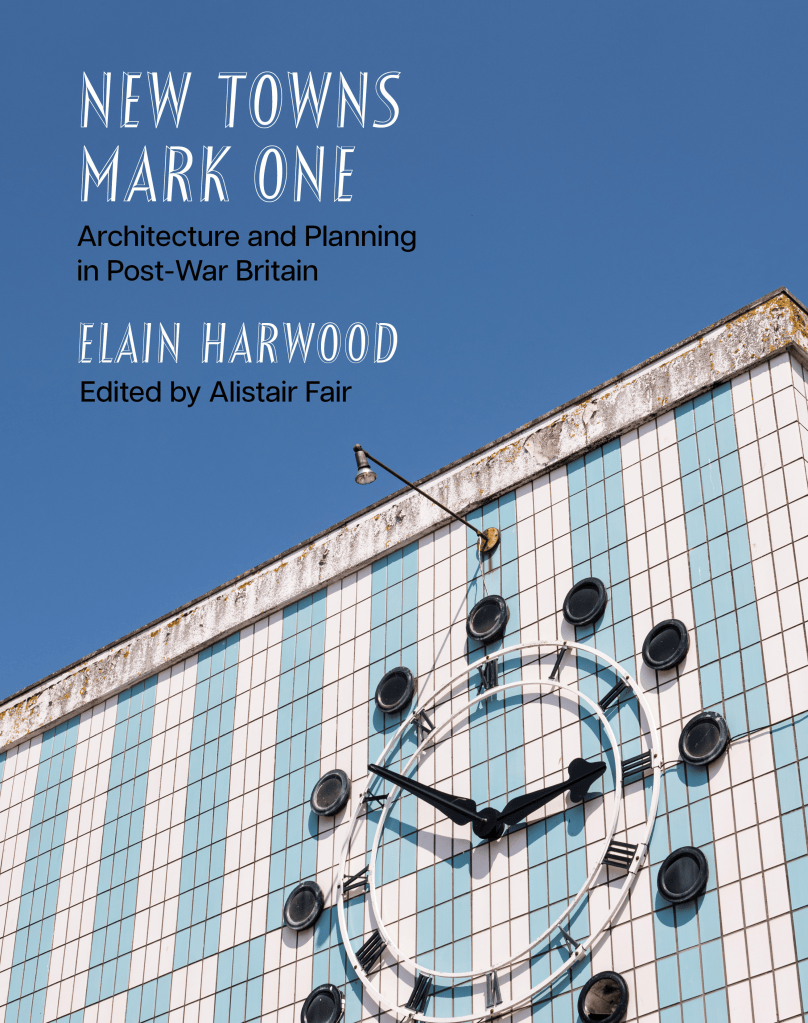
Eighty years ago, in 1946, the New Towns Act set in motion a process which led to the creation of more than twenty-five new towns across England, Scotland and Wales. Although the decades after the end of the Second World War saw a slew of projects to build new communities, the places which were developed using the powers of the New Towns Act – which included Stevenage, East Kilbride, Cwmbran, Runcorn and Milton Keynes – have a special status. These places were regarded at the time as prestige projects, were well-funded, and attracted attention from around the world.
The new towns were begun in several waves between 1946 and the early 1970s. The earliest generation, started between 1946 and 1950, have come to be known as the ‘mark one’ new towns. Their planning and architecture are the subjects of a new Liverpool University Press book, written by the late Elain Harwood and edited by Alistair Fair, New Towns Mark One. These places came into being during a time of austerity and reached maturity during the ‘never had it so good’ years of the late 1950s and 1960s. With housing, jobs, schools and shops, they demonstrated the potential for planning and architecture to embody the post-war Welfare State, and to deliver social and economic change.
One of their key aims was to demonstrate what would now be called ‘best practice’ in urban design. Reformers, drawing on the thinking of Ebenezer Howard and Patrick Geddes, were critical of what they saw as unplanned urban growth during the nineteenth and early twentieth centuries. This, they argued, had resulted in overcrowding and what was considered to be the inefficient mixing of housing and industry. The new suburbs of the 1920s and 1930s, meanwhile, were criticised for their apparently ‘one class’ nature, their homogenous architecture, and for providing little more than housing whilst sprawling across the countryside.
During the Second World War, the foundations were laid for something different. Major planning reports called for the creation of planned, self-contained new towns around London and Glasgow. New kinds of spacious house layout and new ways of building were developed. The scale of the war effort cultivated the idea of an expanded state remit in peacetime. The 1946 New Towns Act created a system in which places would be ‘designated’ as new towns. Their development would then be planned and overseen by a public-sector body known as a ‘development corporation’, which had far-reaching powers. In particular, the corporation built and owned most of the housing built in the ‘mark one’ new towns during the 1940s, 1950s and 1960s. It was also responsible for attracting industry. Many of the corporations developed particular expertise in landscape management, working with leading landscape architects such as Sylvia Crowe and Brenda Colvin.
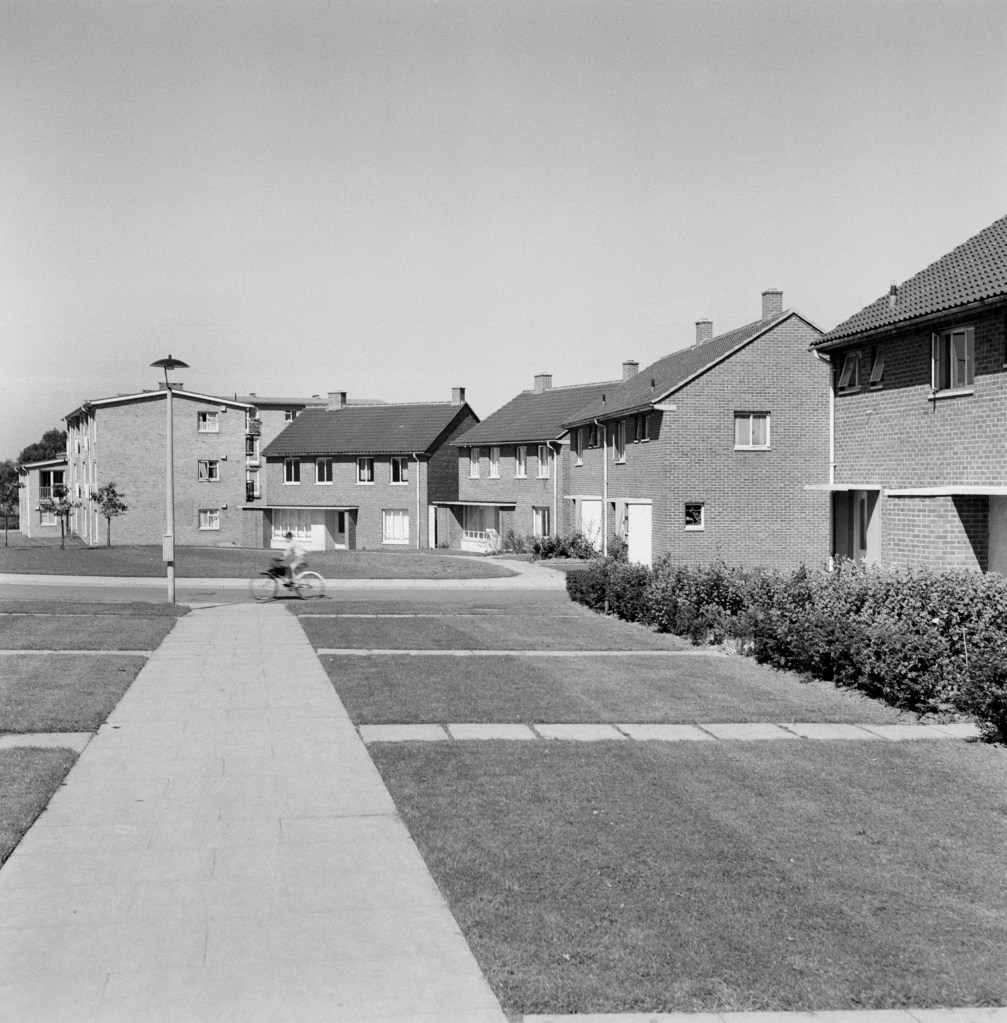
The ‘mark one’ designations offered an immersive glimpse of architectural modernity and defined the image of the new towns in the popular imagination. They were divided into ‘neighbourhood units’ containing a mixture of house types and sizes, often laid out for visual interest in deliberately picturesque ways, with through traffic typically routed away from housing areas. As far as their buildings were concerned, there had been explorations of architectural ‘modernity’ during the 1930s, but now a self-consciously modern architecture was very much to the fore. During the late 1940s and 1950s, this usually meant an approach which blended continuity and change, with brick elevations, pitched and tiled roofs, big windows, and occasional decorative details such as patterned brickwork or tile hanging. Influences came not only from the English terrace tradition, but also the contemporary architecture of Scandinavia and the Netherlands.
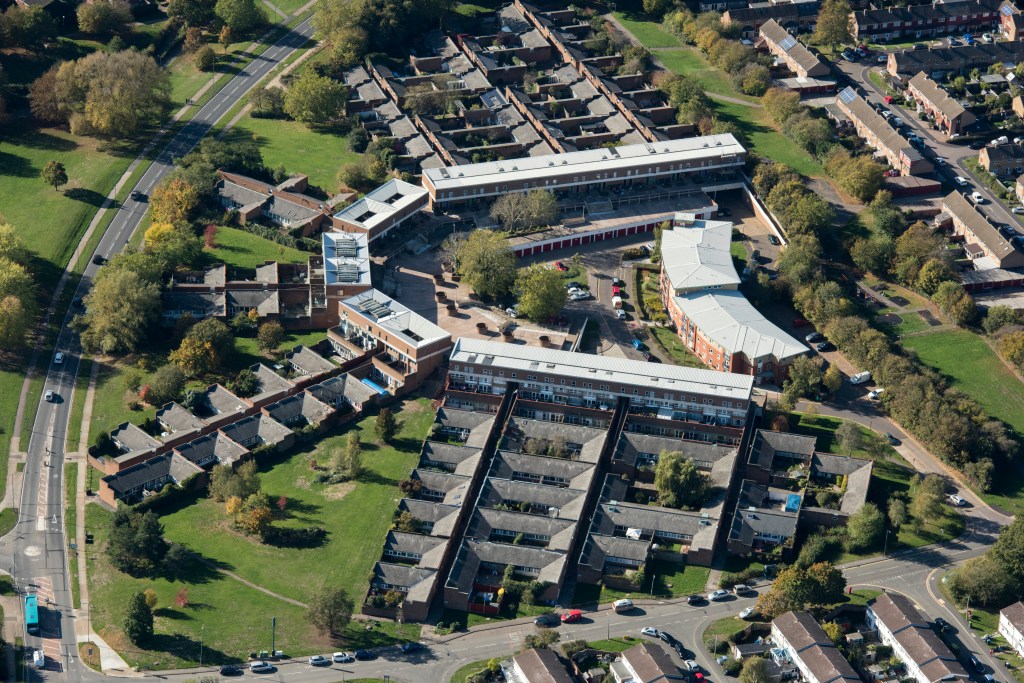
By the 1960s, a somewhat tougher aesthetic was more common, often now described as ‘Brutalism’. Traffic was segregated from pedestrian routes (in what was known as ‘Radburn’ planning), while housing was often arranged in deliberately dense patterns to achieve a greater sense of ‘urbanity’. During the 1970s, more contextual styles came into fashion, and Radburn layouts were rejected in favour sinuous culs-de-sac. In this way, the evolving architecture of the new towns offers a compelling glimpse into broader debates in post-war architecture relating to form, materials and planning, showing how theories informed practice.
New Towns Mark One is the first study to look in detail at this key moment in modern architectural history. It sets out the ideas which inspired the new towns and the circumstances in which the New Towns Act was passed, before turning to consider and contextualise the planning and architecture of each of the ‘mark one’ new towns from the 1940s until the 1970s. It shows how these places were sites of experiment in which a new architecture – and a vision of a new Britain – was realised.
Purchase New Towns Mark One from the LUP website >

Follow us for more updates
Sign up to our mailing list
Follow us on social media
www.liverpooluniversitypress.co.uk

