
Nicholas Cronk and Gillian Pink (Voltaire Foundation) discuss the latest additions to Oxford University Voltaire and how the resource continues to evolve as a living edition, with new content and features enhancing access to and study of Voltaire’s works.
The Complete works of Voltaire (OCV) concluded in 205 print volumes in 2022, and in January 2026 was reborn in digital form, as Oxford University Voltaire (OV). As a living edition, OV can continue to grow as new material comes to light. Its first update, which concerns Voltaire’s marginalia and correspondence, has just been released.
Marginalia
How to digitise the marginalia? This was always going to be one of the great challenges in creating OV. We had thoughts about this thorny question as far back as 2020 (and thought some more in 2022) but there was still a reason why we chose to wait to release these ten volumes after the rest of the edition.
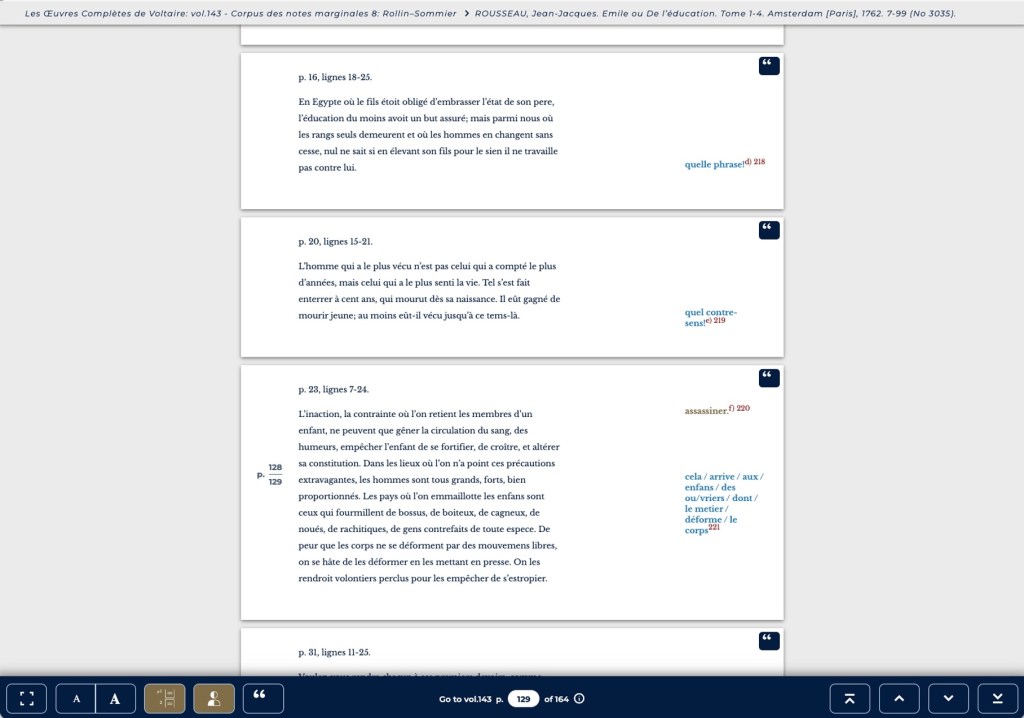
Voltaire left notes and other traces of reading – including the squiggles discussed in the blog posts referred to above, but also involving paper markers inserted between pages, and objects like playing cards and dried flowers that perform the same function – in over 1600 works in his library. To make matters more complicated, he was supported in his reading and annotating activities by his secretaries, and some volumes contain marginalia by other members of his entourage too, most notably scientist Emilie Du Châtelet. This means that in addition to the challenges posed by rendering the shapes and lines, we have been busily encoding the hand in which notes are written so that they can be differentiated more easily by readers, although this information remains present in textual form also via pop-up notes.
The most famous examples of Voltaire’s marginalia will always be those to be found in the pages of his most famous adversary, Jean-Jacques Rousseau. They are lively, argumentative and in places downright insulting: ‘que de futilitez ecrites avec arrogance!’ (What trivialities written with arrogance!) – or, ‘qui te l’a dit?’ (Who told you that?) – or, ‘déclamation puérile’ (Childish declamation). But we are sure that by making these thousands of notes searchable and filterable users of OV will find not only the obvious sound bites but other notes more off the beaten track as well.
Revisions
The digital edition also gives us a chance to revisit the earlier print editions, and to add relevant recent discoveries. As an example of what is now possible, there is a short poem, the Epître au roi d’Angleterre, in OV.1B which turns out to have been printed (perhaps in a single copy!) in Œdipe, edited in OV.1A. The updated edition can be found here: a small detail, but interesting as an example of Voltaire’s assiduity in courting royal personnages.
Correspondence
The aim of OV is first to capture everything in the print edition of OCV, and then to go beyond by incorporating new material. Whistler’s warning that ‘completeness is a reason for ceasing to exist’ is hardly a worry in the case of Voltaire: his œuvre is so large and so intricate that the edition will never be truly complete. And no part of Voltaire’s works is more in need of completion than the correspondence: it was perhaps unfortunate that Besterman named his second print edition of the letters ‘definitive’. Over the next few years, we aim to add hundreds of letters to the Besterman edition, transforming the epistolary corpus as we currently know it.
As an example of what can be done, we are adding in this first update a dozen or so letters, some of which were totally unknown until now, some of which were slumbering in old journals. Sometimes a letter is modest in itself, but can help complete our understanding of a topic. So, in his edition of the Histoire de l’empire de Russie sous Pierre le Grand, Michel Mervaud quotes an extract of a letter from Théodore-Henri de Tschudi to Gerhard Friedrich Müller which is informative about the way in which Voltaire researched details concerning the life of Peter the Great (see OV.46.121). Subsequently, Professor Mervaud, who sadly died earlier this year, found the complete letter and reproduced it in a volume which is not widely distributed: an edition of the letter has now been included in OV (OVD21228), and we dedicate the edition to Michel Mervaud’s memory.
Another addition is the letter of Jean Calas’ widow, Anne Rose Calas written to Voltaire in March 1765, when, after a legal dispute that had lasted three years, she has just received the news that her husband has been fully rehabilitated, thanks to Voltaire’s unstinting efforts (OVD21227). In a lighter vein, another discovery is of a billet that Voltaire wrote to the actress known as Mlle Dangeville. It was sent in 1749, just a few days before she was due to perform in the première of his comedy Nanine at the Comédie-Française. Voltaire was unhappy with the way rehearsals were progressing, and he scribbles this note at midnight, in a combination of humour and panic, to demand that she come to rehearsal the following day. This letter, a fascinating example of the attention Voltaire gave to preparing his actors, was completely unknown when it appeared for sale in London in 2024: it is now safely recorded in OV (OVD21224).
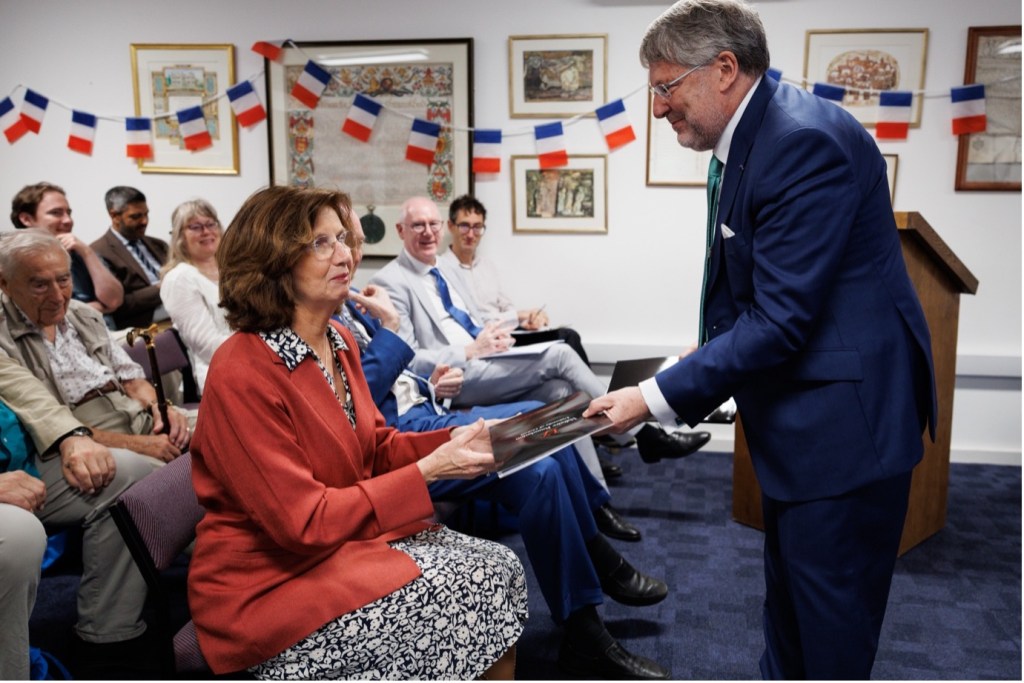
We are grateful to the French Ambassador to the UK, Her Excellency Madame Hélène Duchêne, who formally launched OV in Oxford in June 2026. On this occasion, the first ‘new’ letter, OVD21222, was added to the correspondence. This is a letter written by Voltaire in June 1746 from Versailles to the comte d’Alion, the French Ambassador in St. Petersburg, asking for his help in gaining election to the Russian Academy of Sciences. The autograph letter was recently identified in the diplomatic archives of the French Ministry of Foreign Affairs, and we were delighted to dedicate this edition to Madame Duchêne.
The marginalia is an extraordinary part of Voltaire’s output, and it looks even more remarkable in its digital form. Each of the ‘new’ letters has something fresh or unexpected to tell us about Voltaire. The Complete works of Voltaire are still being completed, which is just as it should be. So please come and take a look at this living edition.
– Nicholas Cronk and Gillian Pink, Voltaire Foundation
For more information, or to request a 30-day free trail, please contact Ellen Appleton (ellen.appleton@liverpool.ac.uk).

Follow us for more updates
Sign up to our mailing list
Follow us on social media
www.liverpooluniversitypress.co.uk

