
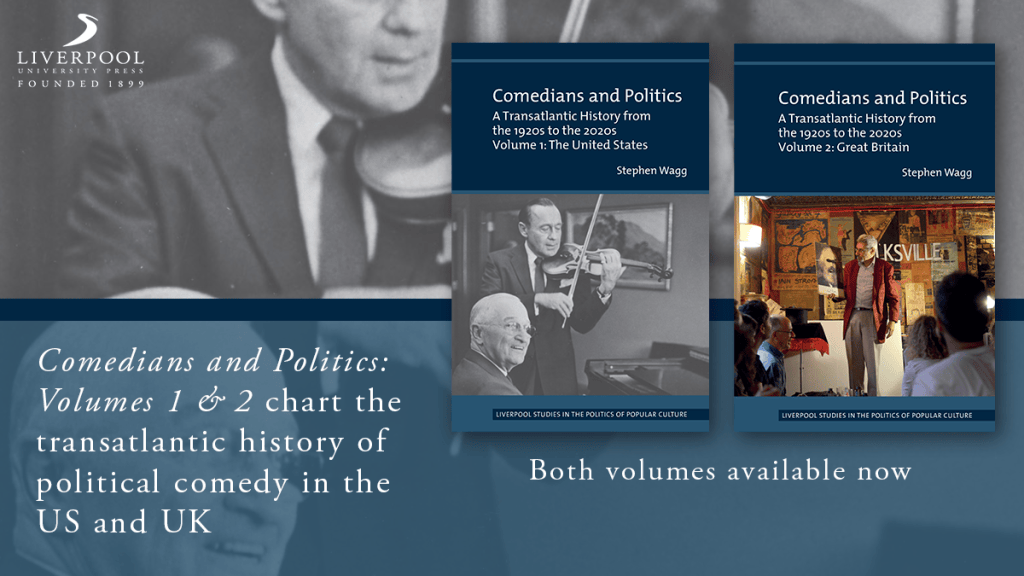
Marking fifty years since the premiere of Trevor Griffiths’ Comedians, Stephen Wagg reflects on the changing role of comedy in modern society. He traces the rise of alternative comedy, the decline of a shared national comedy culture, and the growing influence of comedians in shaping political and social conversations. Stephen is the author of Comedians and Politics: A Transatlantic History from the 1920s to the 2020s Volume 1: The United States and Volume 2: Great Britain, the latest in LUP’s Liverpool Studies in the Politics of Popular Culture series.
It’s fifty years since the stage play Comedians premiered on Broadway. Written by the socialist playwright Trevor Griffiths, then in his mid-30s, and first performed at the Nottingham Playhouse the previous year, it raised questions about comedy that few people could recall being asked before. Griffiths had grown up in the working-class district of Ancoats in Manchester and had taken strong objection to a TV series called The Comedians, begun on ITV in 1971, which showed frilly-shirted, bow-tied male stand-ups dispensing their usual fare – jokes about wives, mothers-in-law, the Irish… in the setting of a working men’s club. The Comedians was popular. It had 6 million viewers, was nominated for a BAFTA award and was succeeded by the similar The Wheeltappers and Shunters Social Club in 1974. But the show ignored the cultural shifts of the 1960s, a decade in which issues of social class, gender and race had begun to be confronted. Griffiths called the standard jokes of the show ‘lead pellets’ and in his play uses the device of an evening class being tutored in comedy performance to make his point. The tutor has urged his students to be sensitive to social inequalities, memorably suggesting to them that ‘a joke that feeds on prejudice starves its audience’ and chiding one for a ‘joke that hates women’. The external examiner, however, is old school and warns his examinees that he’s looking for ‘comics, not missionaries’; the comedian’s job, he insists, is to give people what they want. The students variously oblige him but the final candidate delivers a performance of working-class rage, abusing his stage props – a couple of upper class dummies, wearing evening dress – and chanting for Manchester United.
What was at the time called ‘alternative comedy’ began to be practised soon after and many of the early performers, now in their late 60s and early 70s, will say that they took inspiration from Griffiths’ play. Indeed, it’s possible to discern comic rage of the play’s rebel student in the early work of Alexei Sayle. After 1980 the ‘lead pellets’ – indeed, conventional jokes of any kind – began to disappear and comedians proliferated: there is now a cluster of comics to cater to any social demographic. The bow-tied comedians didn’t go away, of course; for example, Bernard Manning, born in Ancoats five years before Griffiths, continued to thrive on his narrow diet of bought-in jokes about Pakistanis and ‘the wife’ until his death in 2007. But, instead of being seen simply as ‘comedians’ they were now styled, in a way they barely understood, as comedians of a certain kind – ‘right wing’ say, ‘old fashioned’ or ‘racist’.
One clear consequence of this is that there is no longer a national comedy. Families across the country last sat chuckling at the Morecambe and Wise Christmas Show in 1977 and Victoria Wood, who in 1993 sold out the Albert Hall for 15 consecutive nights is arguably the last British comedian to have a national constituency; she died in 2016.
This process had begun earlier in the United States. There comedy had long been corporate, via sponsored radio and TV shows, vetted by advertising agencies and dominated by wisecracking, ex-Vaudeville white males such as Bob Hope. As later with Griffiths, this comedy was increasingly seen as remote from real life. ‘Audiences nowadays want to know their comedian’, said a young Joan Rivers (27 in 1960). ‘Can you please tell me one thing about Bob Hope? If you only listened to his material would you know the man? His comedy is another America, an America that is not coming back’. Female comics like Rivers and Phyllis Diller and black comics such as Dick Gregory, Bill Cosby and Richard Pryor stepped up in the 1960s to joke on behalf of the other Americas.
The United States: The Comedians are in Congress
Last year marked the 50th anniversary of Saturday Night Live, the TV sketch show that specialises in spoofing US politicians. SNL grew, arguably, out of the tradition of ‘kidding the President’, cultivated by humourist Will Rogers in the 1930s. Rogers, like Hope, enjoyed a cheeky intimacy with American presidents and this intimacy was reproduced in Saturday Night Live – President Gerald Ford introduced one of the early shows. Indeed, Donald Trump appeared on SNL in 2004 and again in 2015, the year before he was first elected President. However, over the 51 years of SNL, the relationship between comedians and the American polity has seen a perceptible shift. According to polls a majority of young Americans now regard Comedy Central as the most credible source of political information and comedians are influential spokespeople across the political spectrum. For instance, comedian and podcaster Joe Rogan is a key figure in Trump’s MAGA coalition while the Daily Show’s Jon Stewart rivals Bernie Sanders and Alexandria Ocasio-Cortez as the voice of America’s liberal left.
Back in the 1930s Will Rogers and others were fond of saying that Americans were taking their comedians seriously and their politicians as a joke. It was a throwaway line then; it isn’t now.
Stephen Wagg is retired as Professor of Sport and Society at Leeds Beckett University in the UK in 2019. He is currently an Honorary Fellow in the International Centre for Sport History and Culture at de Montfort University, Leicester, and Visiting Professor at Newcastle University. He is the author of Comedians and Politics: A Transatlantic History from the 1920s to the 2020s Volume 1: The United States and Volume 2: Great Britain.

Follow us for more updates
Sign up to our mailing list
Follow us on social media
www.liverpooluniversitypress.co.uk

