
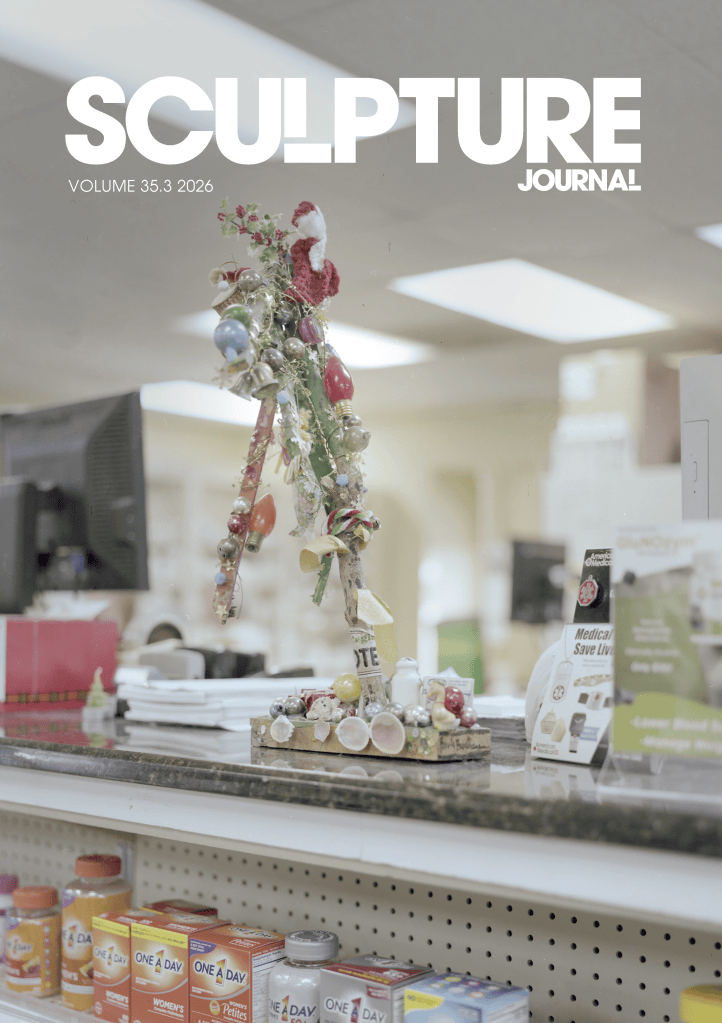
The editors of Sculpture Journal have selected the following paper as the Featured Article in Sculpture Journal 35.3.
Florescence of power: Benvenuto Cellini’s Narcissus as a botanical allegory in the court of Cosimo I de’ Medici by Alexandra Dvorkin reconsiders Narcissus (1548–65), Benvenuto Cellini’s marble sculpture, as a sophisticated botanical-political statement rather than merely a mythological rendering.
This article will be Free to Read for a limited time.
We invited the author Alexandra Dvorkin to introduce the article and highlight its importance:
Narcissus by Benvenuto Cellini (1500–71) is an enigmatic sculpture carved from a prized block of Greek marble that belonged to Cosimo I de’ Medici (1519–74), Duke of Florence. The sculpture draws on Ovid’s Metamorphoses, but, on closer examination, it does more than render the familiar myth of the beautiful youth transformed into a flower. Cellini gives unusual prominence to vegetal motifs and to the process of transformation itself – not only that of Narcissus, but also of nature. After the artist’s death, the sculpture – which remained in his studio – was inherited with his other artworks by Cosimo’s son, Francesco, and eventually installed in the Pratolino Gardens and then in the Boboli Gardens. What first drew my attention to Narcissus was its rich botanical imagery. This initial curiosity was further fuelled by the unresolved questions surrounding the sculpture’s commission, intended location, and choice of subject, eventually leading me to undertake an interdisciplinary study. These questions became the starting point for reconsidering a work about which surviving information is limited, and which has received relatively little sustained attention.
Narcissus had been studied before, especially in the context of the paragone – the battle for supremacy between painting and sculpture during the Italian Renaissance – but remained peripheral within modern scholarship. It was somewhat obscured by the shadow of Perseus (1545–54) and other bronze sculptures in Cellini’s oeuvre, and was often treated as part of a trio with his marble Apollo and Hyacinth (c. 1546–71) and Ganymede (1548–50), which discouraged its individual examination. Similarly, among the numerous studies dedicated to Cosimo and his artistic patronage, Narcissus, for which no evidence of a commission survives, was not regarded as significant. The aim of the study was to challenge these perceptions by reframing Narcissus through its botanical imagery. Following the botanical question along both axes – Cellini’s artistic ambitions and Cosimo’s political and cultural interests – proved fruitful, bringing the two strands of the research together. Through this lens, Narcissus emerges not as a minor mythological sculpture, but as a sophisticated statement about artistic invention, scientific curiosity, dynastic legitimacy, and Medici power.
To construct the full context in which to place Narcissus, I examined the political, artistic, scientific, and cultural realities of the mid-sixteenth-century Florentine court, Cellini’s earlier artworks, and the Ovidian myth of Narcissus, alongside other potential textual influences. Cosimo’s humbler origins and political inexperience, in comparison with other rulers of his time or even his own predecessor, put him in an inferior position, with a need to prove his legitimacy. His personal interest and erudition in plants coincided with the rise of botany, allowing the young duke to present himself as a scientifically progressive and enlightened ruler. Cellini, at the same time, had an aim of his own: to create a work through which he could put into practice his arguments for sculpture’s superiority over painting in the paragone debate. The article argues that the sculpture’s specific vegetal imagery was likely shaped by Pietro Andrea Mattioli’s (1501–77) bestselling illustrated herbal, a work that Cellini could plausibly have encountered through the botanical culture fostered under Cosimo’s patronage. Thus, in Narcissus, Cellini brought together literary sources from different genres and his own sensitivity to nature with a commemoration of Cosimo’s botanical pursuits and a celebration of the prosperity he brought to his court.
If you are based at a university or research institution, please consider recommending a journal subscription to Sculpture Journal to your librarian. Institutional subscriptions provide full online access to the complete archive—nearly 30 years of scholarship dating back to 1997—and support the ongoing publication of this vital resource.
Also of interest: The 2026 Free Issues: Read a free issue of each journal.

Follow us for more updates

