
In this blog post, author Nic Madge discusses his new book The Infernal Tambopata: British Slavery in Twentieth-Century Peru and Bolivia, and how distant family ties led him to research this fraught and devastating recent history.
The Tambopata is a river in a remote region of Amazonia, on the borders of Peru and Bolivia. It was also the name of a British rubber company, the Tambopata Rubber Syndicate.
The Infernal Tambopata is an exposé of British slavery in the twentieth-century. It reveals how between 1907 and 1913 – a little over 100 years ago – the Tambopata Rubber Syndicate enslaved over 700 indigenous Peruvians and Bolivians to extract rubber. Conditions were brutal: workers were flogged for the most minor misdemeanour – sometimes for no reason at all. There was appalling sexual abuse of women and girls. Workers were imprisoned in the Tambopata Valley. They were not allowed to leave unless given a passport signed by a manager – that permission was rarely given. If workers escaped, the managers sent posses of men on muleback to hunt and recapture them. Over one fifth of the workforce died. I have found the names of over 150 identifiable people who were killed. They died from disease and starvation. Some were shot when they were recaptured after escaping. When a judge came to investigate the killing, the company bribed him and the case was dropped. Some of the details are spine chilling.
So, how did I come to research this?
I have always been interested in history. Many years ago, I wrote a book, English Roots, describing the day to day lives of ten generations of my mother’s family. It portrayed English social and economic history as seen through the eyes of one family – living in the Derbyshire Peak District and then moving to Manchester in the Industrial Revolution.
But there was a loose end. One of my mother’s uncles, one of my great uncles, Valentine Ashton, left Manchester in 1908 and spent the rest of his life in South America. No one really knew much about what he did.
There was though one clue. In 1953, one of his daughters sent him a copy of a book, Exploration Fawcett, written by famous British explorer Percy Fawcett. Valentine wrote back mentioning that Fawcett had stayed with him and a man called Lawrence at two places called San Carlos and Marte. None of my relatives knew anything about Lawrence – and San Carlos and Marte were not shown on any maps.
Eventually, I tracked down Fawcett’s hand-written diaries to the Torquay Museum. They did not mention my great uncle, but they did mention Lawrence. Fawcett described Lawrence as “fat and degenerate” – a man who flogged the indigenous people and bought young children to work as his personal servants in exchange for rusty old shotguns. Fawcett wrote about men and women dying from starvation and disease. This was something that I had to investigate. As I pulled at the loose thread, the whole fabric unravelled.
Next, I found the diary of Dr James Murray, Fawcett’s biologist, in the National Library of Scotland in Edinburgh. Murray described conditions of slavery in even more detail. According to him, Lawrence was “far advanced in evil” and kept a thirteen-year-old mestizo girl at San Carlos, while he had a wife in La Paz.
Another of Fawcett’s colleagues, writing after World War 2, described Lawrence “as a sort of half brother to Goerïng; fat, vain, lazy! … When he bathed in the river, two Indians went with him, to strew palm leaves on the ground where he sat, and one took off and put on his clothes; the other dried him.”
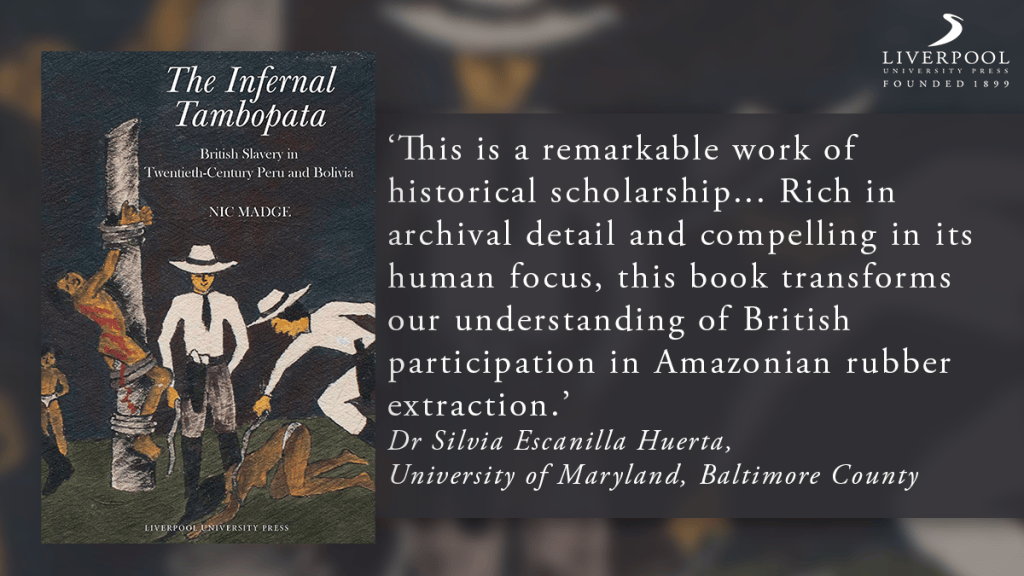
I found other eye-witness accounts in letters and diaries. Correspondence to and from Sir Roger Casement, then a diplomat, referred to the evils being perpetrated on the Tambopata. Complaints were made to the Peruvian Pro-Indigenous Association and to the Anti-Slavery Society in London. British diplomats in Lima and La Paz heard about the abuse and wanted to investigate, but were instructed by the Foreign Secretary, Sir Edward Grey, that they should not enquire further. And when questioned about slavery in the Peruvian rubber industry, British Prime Minister Asquith misled the House of Commons. He lied.
This research confirms irrefutably that this was a brutal form of slavery. It shows that slavery did not end on abolition in the first half of the nineteenth-century. Nor was British slavery limited to the British Empire or to what became the United States. A British company, with British capital and British managers enslaved and killed people during the twentieth-century. And the British and Peruvian governments helped to cover it up.
The Infernal Tambopata exposes the contradictions between the British government’s professed opposition to slavery and the way in which it pursued the country’s political and economic interests. The book also bridges the gap between literature on traditional chattel slavery and contemporary forms of slavery – and in my final chapter I make comparisons with the contemporary forms of slavery that are prevalent today.
Nic Madge
The Infernal Tambopata is available to purchase via the LUP website now.
Nic Madge spent four decades at the heart of the English legal system as a human rights solicitor and Circuit Judge. He also wrote books, contributed to journals and gave lectures. In parallel, he researched social and economic history. The Infernal Tambopata reflects his skills and experience. It is the product of detailed research, careful analysis of evidence, clear writing and a commitment to justice and fairness. He is a Fellow of the Royal Geographical Society.
Interested in Slavery Studies?
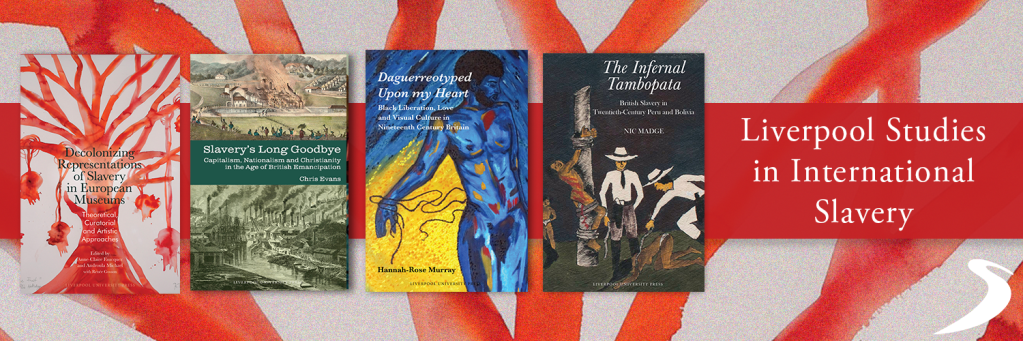
Published in association with the Centre for the Study of International Slavery at the University of Liverpool, the Liverpool Studies in International Slavery series aims to deepen our understanding and foster informed debate about slavery in its many dimensions. By adopting international, comparative, and interdisciplinary approaches, it examines the origins, practices, resistance, and aftermath of slavery across different societies and historical periods.
Learn more about the series and discover new and forthcoming titles here
Follow us for more updates
Sign up to our mailing list
Follow us on social media
www.liverpooluniversitypress.co.uk

