
Emancipatory Narratives & Enslaved Motherhood: Bahia, Brazil, 1830-1888 examines three major currents in the historiography of Brazilian slavery: manumission, miscegenation, and creolisation. It revisits themes central to the history of slavery and race relations in Brazil, updates the research about them, and revises interpretations of the role of reproduction and gender within them. In this blog post, author Jane-Marie Collins (University of Nottingham) offers an insight into the research and writing of this new book, and how this project was – and remains – an ongoing learning process.
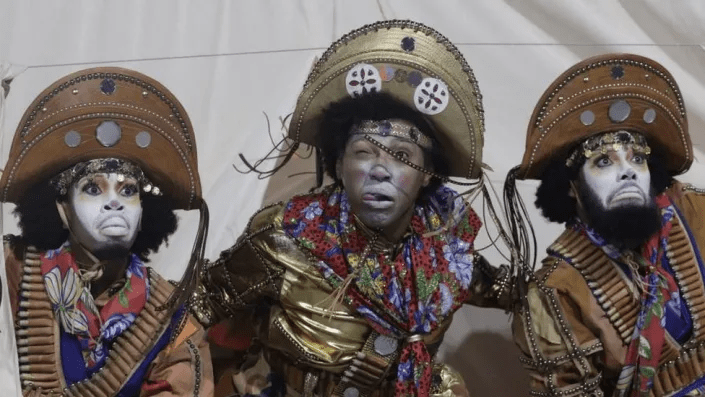
Two historical subjects battled it out for the best samba school parade in Rio de Janeiro’s carnival last year. One was the figure that first drew me to Bahia in the early 1990s as an undergraduate student interested in social banditry: Virgulino Ferreira da Silva, otherwise known as Lampião. The other belongs to a different historical period, place, and category of historical analysis: Rosa Maria Egipcíaca, an enslaved African woman of the Benin region, and the Courá ethnic group (a variation of Courana/Kuramu), kidnapped and enslaved as a child during the eighteenth-century gold rush that fuelled the transatlantic slave trade to Brazil. It was the lives of African and African descendant women like Rosa, not twentieth-century social bandits, that kept me in Bahia and in the archives for the whole of my year abroad as an undergraduate student, for almost two years as post-graduate student and then for a string of shorter stays as an academic. Emancipatory Narratives is the result of decades scrutinising archival documents pertaining to the lives of African women and their descendants, in slavery and in freedom, and for the most part asking the same questions about how they navigated between one condition to other, why they failed and how they succeeded. A great deal has changed in Brazil and in the historiography of slavery since the 1990s, but in my mind at least, some issues remained unresolved.

Brazil was one of the largest slave societies in the Americas. Around 40 per cent of Africans made captive in the transatlantic slave trade disembarked in Brazil. It took two acts of legislation to end the slave trade to Brazil (in 1831 and 1850) and Brazil was the last nation in the Americas to abolish slavery (in 1888). These, and other features, make Brazil standout in the history of slavery in the Americas. The other main distinguishing features are manumission and miscegenation which, while not unique to Brazil, were articulated differently–demographically and discursively–both in the era of slavery and beyond. By the end of the eighteenth-century the fastest growing sector of the free population in some of the oldest slaveholding regions in Brazil were people of colour. Although many were of mixed racial heritage, including indigenous descent, most free people of colour were of African descendant. Some were sons and daughters of freed parents and were therefore born into freedom. Others were formerly enslaved, manumitted Africans and Afro-Brazilians.

In contrast to the US (to which Brazilian slavery is most frequently compared) there were no laws against manumission in Brazil. Nor were there any anti-miscegenation or racial segregation laws post-abolition either. These differences gave rise to notions of a more benign form of slavery and a more tolerant form of race relations in Brazil, otherwise known as ‘racial democracy’. While theoretically and politically this mythical version of race and slavery in Brazil has been largely discredited, historiographically a discursive deconstruction of race and gender within the twin processes that underpinned it—manumission and miscegenation—has proved more stubborn. Indeed, although we no longer rely solely on a data-driven approach to manumission and there is a more nuanced appreciation of the dynamics of race, ethnicity, and gender within manumission in Brazil, the scholarship has struggled to shake off a gendered and racialised lexicon that has, unwittingly or not, reproduced slavocrat sentiments and the semantics of racial democracy. In Emancipatory Narratives, I make the case for alternative ways to speak to the prevalence of women and children in manumission other than through slaveowner paternity and affective relations with slaveowners. In addition, I challenge the tendency to seek meaning for differential outcomes around race and sex based on perceptions of ease, advantage, benefit, and privilege of some groups of enslaved over others. Alternatively, the gendered and racialised praxis of the emancipation of women and children is regarded as a response to maternal dispossession in slavery and the pursuit of reproductive justice in freedom rather than the relative benefits and advantages of females over males, children over adults, Brazilians over Africans, and light skin colour over blackness. In addition, through the interpretative framework of emancipatory narratives the emancipation of women and their children through manumission and freedom suits is read as a refusal of reproductive slavery; emancipatory actions that predated the Free Womb Law (1871) and the abolitionist movement in Brazil.
Hence, the prevalence of women and children in both manumission and freedom suits is regarded as a form of emancipatory activism; a comprehensible response to the trauma and terror of maternal dispossession and reproductive slavery confirmed demographically in a low number of children in the transatlantic slave trade, low levels of maternity among enslaved women, and high levels of infant mortality among the enslaved in Brazilian slave society. In this context it is argued that the primary historical imperative that informed enslaved women’s strategies for freedom for themselves and their children, was a maternal logic that was also female-centric. Freeing the enslaved who were female made sense if the aim was to rid subsequent generations of the condition of enslavement. Finally, rather than maleness and paternity it was femaleness and maternity that increased a child’s chances of freedom in three ways: being a female child, having a female slaveowner, and most importantly of all for the child to remain with their mother who usually remained enslaved when her child was freed.

While the demographic profile of manumission in Brazil was similar to other slave societies in the Americas, the historical narratives of race and gender emanating from manumission and miscegenation have been mobilised differently in Brazil, in both the popular imaginary and academic scholarship. In the first half of the twentieth century, the ‘mulatta’ became a marker of Brazilian cultural identity: in literature, cinema, theatre, popular music, TV dramas, advertising, and tourism. This elevation of miscegenation as a racial ideal through the myth of racial democracy was, from the 1930s onwards, epitomised and propagandised through the work of Gilberto Freyre. In the mid-twentieth century, social scientists challenged the empirical validity and accuracy of claims about racial democracy in Brazil. Later, and especially after the end of military rule in the 1980s, scholars began to critique the history of race and slavery and scrutinise the archive more closely. The documentary evidence historians uncovered discredited, conclusively, the notion of slavery in Brazil as benign.
It was against this backdrop that I started out research into the lives of enslaved and freed women in the archives in Bahia in the early 1990s. And, if the truth be told, it took me much longer to work out what I had to say about women in slavery and freedom in Brazil than it did to find the documents about them in the archives. In fact, the core sources for Emancipatory Narratives comprise a relatively small bundle of archival documents: a handful of freedom suits of women and children, a few dozen wills and testaments for African and African descendant women, and four hundred or so letters of liberty for children. On reflection I realise that, as someone who is neither Brazilian nor of African descent, I needed the frame and terms of reference of debates about race relations to change before I could begin to formulate something worthwhile saying about race and slavery in Brazil, a change that did not take place until the second decade of the twenty-first century.

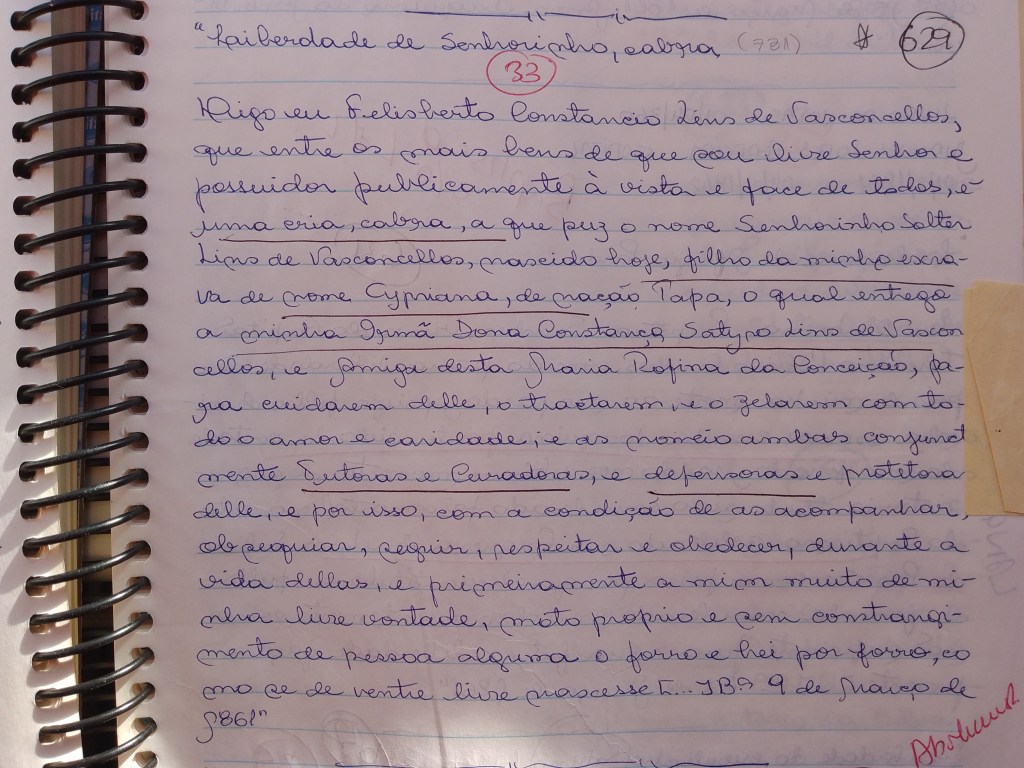
In this sense, the final order of the book belies its very disorderly chronology: the interpretative framework outlined in the introduction for Emancipatory Narratives came very late in the process of researching and writing and some minor but critical bits of historical evidence were shoehorned in at the proof-reading stage. A reminder of the longevity of the project sits on my bookshelves: a dozen or so hardback notebooks, the kind used by school children, full of handwritten transcripts produced by myself and indispensable research assistants who spent months hunched over fading primary sources, also handwritten and often in archaic language. These books pre-date the affordability of laptops, not to mention digital cameras and iPhones which, while speeding up the process of collecting and storing sources, only delays the protracted process of making meaningful historical connections between them, the real research. The labour required remains the same even if the time spent in the archive has been reduced.

As most historians will tell you, every archive generates its own historical narrative. The state archive in Salvador da Bahia—Arquivo Público do Estado da Bahia (APEB)—is no exception. It is housed in an exquisite sixteenth-century Jesuit building which, while providing ample space and peaceful environment for visitors, does not provide suitable conditions for the vast archive of historical documents. Over the years, there have been many controversies about the management of the archive and the ownership of the building, but perhaps the greatest one is also one of the latest: the auctioning of the building under what can only be described as very suspect circumstances. Other news though is more of a cause of celebration than concern, namely the appointment of professional archivist, Jorge da Cruz Vieira, as APEB’S first black director. And while a first for APEB is it not a first for the sector. If follows the appointment of professor of history from the University of Brasília, Ana Flávia Magalhães Pinto, to the prestigious position of Director General of the National Archive in Rio de Janeiro. Two of the most important archives in the history of slavery in the Americas and the history of the transatlantic slave trade are now led by Brazilians of African descent. Their appointments are part of the wider socio-cultural and political changes re-shaping contemporary Brazil; changes which make it possible to change the conversations about the history of race and slavery in Brazil too. Taking the time to be attendant to those changes and those conversations is one of the reasons (and there are many) that Emancipatory Narratives took so long to finish. It was a learning process, and an ongoing one.

Follow us for more updates
Sign up to our mailing list
Twitter | Instagram
www.liverpooluniversitypress.co.uk

