
The editors of International Development Planning Review (IDPR) have selected the following paper as the Featured Article in IDPR 48.1-2.
‘The necropolitics of informality: contested strategies of banishment, carceralisation and peripheralisation’ by Ilda Lindell and Zeferino Ugembe.
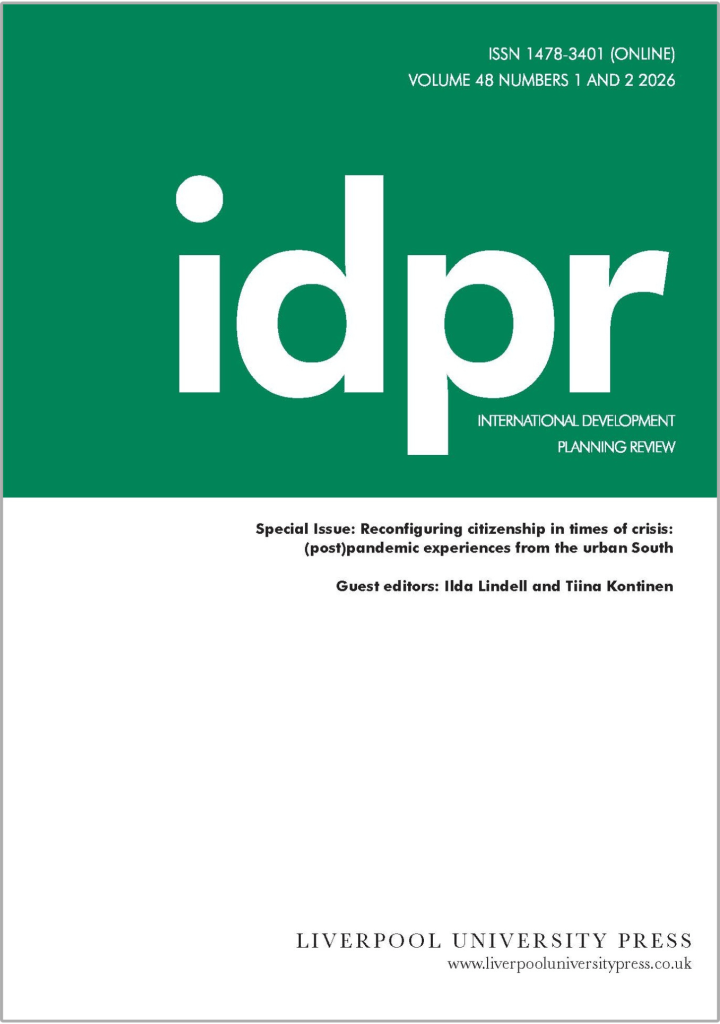
This article will be Free to Read for a limited time.
To mark this Featured Article, we invited the authors to share their thoughts on the piece and its importance.
……………………………………………………………………
Many residents in Southern cities work and live in an informal ‘grey space’ between recognition and unrecognition which makes them vulnerable to shifts towards violent ways of governing. The article proposes necropolitics of informality as an analytical lens to unpack the processes at work when violence becomes a prominent mode of governing urban informality. The analytics of necropolitics, first articulated by Achille Mbembe, foregrounds a distinct mode of rule that operates beyond the law and uses violence and death-fostering methods to control populations and territory. Necropower actively differentiates populations between valued and expendable categories, between those who deserve protection and those who can be exposed to violence or life-debilitating conditions.
The article argues for the usefulness of such a lens for widening existing understandings of the political dynamics of informality. Necropolitics exceeds other modalities of power and politics and is not easily captured by familiar framings that focus on practices of deregulation and ‘un-mapping’, clientelist relations, the shaping of docile subjects, or how the displaced negotiate their ‘right to the city’. The necropolitics of informality that we delineate seeks to extendsuch framings by illuminating how the selective deployment of violence upon certain informal spaces and bodies is associated with the political determination of life’s value and with deliberate processes of dehumanisation and political dispossession.
To illuminate the important role of spacein the necropolitics of informality, we draw upon additional literatures and conceptualisations focusing on practices of banishment, carceralisation and peripheralisation. We reframe these practices as ‘necropolitical spatial strategies’ and view them as useful heuristics for elaborating on the concrete operations of necropower.
We then apply the proposed conceptual lens to examine a major necropolitical shift in Maputo, Mozambique. Violent ways of governing street work intensified across the city, under the pretext of a pandemic threat. In central Maputo, the return of necropolitics after a decade of tolerance put an end to political dialogue, as street workspaces were re-classified as unauthorised. The article discusses the political, social and spatial processes and experienced effects of the deployed necropolitical strategies. Through banishment, street vendors were expelled violently from the city centre and scattered throughout the city. Through carceralisation, vendors were confined into markets and a form of siege where many could not sustain their livelihoods, while others were unable to access stalls in viable locations. Through peripheralisation, street-based businesses selling and repairing electronics were relocated to the urban fringe. These strategies were accompanied by diverse socio-material processes, such as the proliferation of fences around markets, that worked as necropolitical artefacts of separation. Attending to these multiple necropolitical strategies, we argue, helps bringing to light the diversity of processes and experiences, and the variety of spaces and spatialities that emanated from the necropolitical governing of informality.
The combined deployment of the above necropolitical strategies generated a series of deliberate dispossessions. It sought to obliterate the material conditions of vendors’ existence in the city centre and dismantle the life-worlds that supported the livelihoods of thousands. Importantly, the article claims, it also entailed multiple forms of political dispossession: a disqualification of vendors as political subjects, the ending of a governance agreement, a weakening of political ties, as well as the calculated destruction of collective organisation among the street vendors through tactics of deception.
The article interrogates what kinds of agency can be enacted from such disinherited positions. In Maputo, the expelled vendors actively subverted necropolitical strategies by challenging spatial bans and redrawn boundaries. Despite increased exposure to violence, their daily pursuit of life frustrated necropolitical goals. However, the article also uncovers how necropolitical strategies were to some extent mediated and facilitated by vendors’ representatives. Many thus felt betrayed by all and resorted to rioting – raising the question of whether a revival of necropolitics may contribute to a particularly explosive politics of informality.
In our proposition of a necropolitics of informality, we seek to bring together research on urban informality and necropolitics scholarship, that rarely cross paths, with the hope of enriching both.
Research for this article was funded by the Swedish Research Council for Sustainable Development (grant number 2020-02029).

IDPR is part of LUP Open Planning, Liverpool University Press’s Subscribe to Open initiative.
With the support of subscribing institutions LUP Open Planning can provide:
✔ Immediate OA to the latest content for readers everywhere
✔ No Open Access fees for authors
✔ Greater visibility and impact for published research
✔ Subscribing institutions gain exclusive access to the IDPR archive from 1979
If you would like to support Open Access please use our online form to recommend a subscription to your librarian.

Follow us for more updates
Sign up to our mailing list
Follow us on social media
www.liverpooluniversitypress.co.uk

