
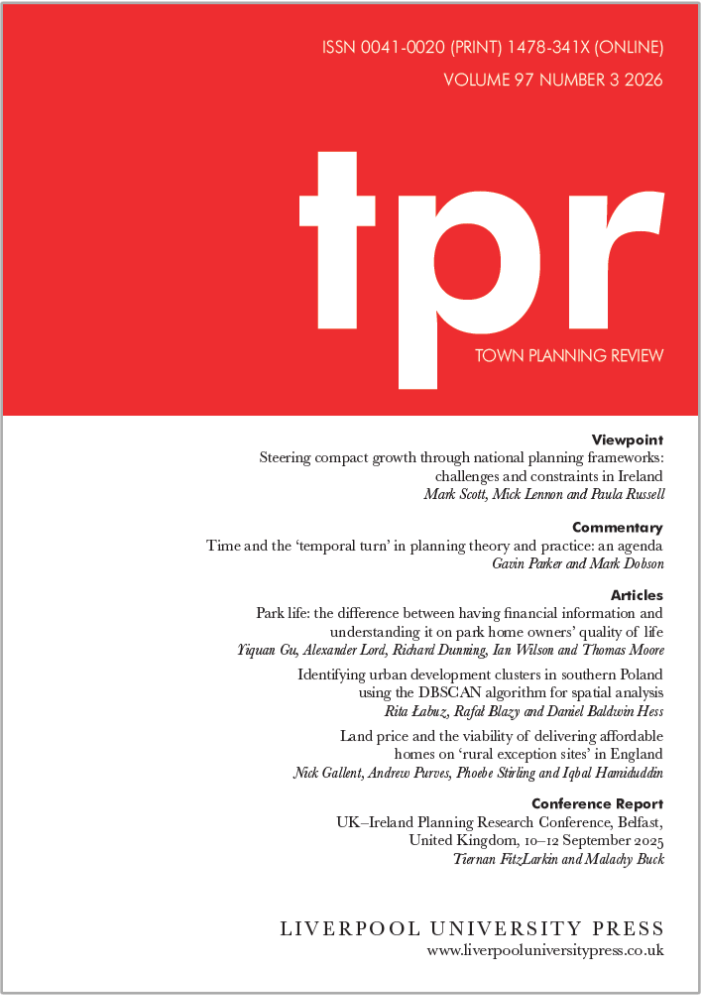
The editors of Town Planning Review (TPR) have selected the following paper as the Featured Article in TPR 97.3.
Land price and the viability of delivering affordable homes on ‘rural exception sites’ in England, by Nick Gallent, Andrew Purves, Phoebe Stirling and Iqbal Hamiduddin.
This article will be Free to Read for a limited time.
We invited author Nick Gallent to share his thoughts on the piece and its importance:
The high cost of land in many rural areas makes it difficult to provide affordable housing. Land prices, especially in amenity areas, have spiked because of increased connectivity to urban sources of housing demand – for retirement, holiday lets and second homes. These same areas are also washed over by layers of planning restriction, increasing the scarcity value of housing and the difficulty of building new homes for local need. The focus of this article is land and hence housing affordability, and particularly the means of bringing down land costs and delivering the homes that communities need. This endeavour is often spearheaded in England by registered providers of social housing – more commonly known as ‘housing associations’.
Housing associations work with enablers, communities, local authorities and contractors on the development of ‘rural exception sites’ (RES). These are land releases outside of the ordinary site allocations process. When land is allocated for housing in an area of high demand within a local plan, its value will soar. Allocation, and the anticipation of a planning permission, unlocks floating value. RES is a land deal that tries to stop that from happening. A landowner is offered the chance to develop their land for local need rather than full residential value, at a price that supports affordability. Farmland values and housing use values are miles apart, with the latter as much as 250 times the former in some parts of England. Standard land release produces market development: on bigger sites, some of the value is clawed back using s106 agreements to procure a percentage of affordable homes. But on small sites in villages, that scale of release or development is often inappropriate. Sites are therefore kept out of allocations but landowners participating in RES can achieve 10 to 15 times agricultural value for their sites: far less than full residential, but far more than is normally possible for farmland.
However, land price expectation for RES has grown. Successive governments have channelled less grant through Homes England, meaning that site viability (and the overall project) must be achieved without subsidy support. From 2012, RES were allowed to have some market homes on them, to cross-subsidise the building of non-market, affordable homes. In 2018, government moved the goalposts again, signalling a willingness to allow landowners and developers to lead their own (first home) exceptions without a housing association or direct community partner. These shifts represent an incremental marketisation of RES, shifting landowner price expectation.
If landowners want more for their land, then either RES lose viability or the homes built become less affordable, switching from social to affordable rent – defined as 80% of market rent. The article details these challenges and others through case studies constructed from interviews with local partners at sites across England. Housing Associations are adept at overcoming barriers but are swimming against a powerful tide. The market logic pervades all, frequently being presented as the silver bullet that will address communities’ needs for affordable homes. In reality, RES work best where the market is kept at arm’s length. More broadly, communities require greater control over their own land resources, enabling the delivery not only of affordable homes but the full range of infrastructures that support their viability and vitality.

TPR is part of LUP Open Planning, Liverpool University Press’s Subscribe to Open initiative which successfully made the latest content from the journal open access for four consecutive years.
Unfortunately, the initiative did not secure sufficient support to publish open access in 2026. We remain committed to rebuilding support for 2027 and thank those institutions that continue to subscribe.
Please note that institutions without an active subscription no longer have access to the latest content or the complete online archive, which are available exclusively to subscribing institutions.
To access the journals’ current content and full archive, please recommend a subscription to your librarian.
Recommend TPR to your librarian >
Also of interest: The necropolitics of informality: contested strategies of banishment, carceralisation and peripheralisation | IDPR 48.1-2 Featured Article

Follow us for more updates

