
By Alice Burns and Paul Cockburn
Back in March, the British Academy Early Career Research Network (i.e., the ECRN) hosted their annual Book Publishing Conference in Liverpool, to coincide with Redux, an industry event organised by the Association of Learned and Professional Society Publishers (or, ALPSP).
Your correspondents are two Early Career Researchers (ECRs)—hot-off-the-press (so to speak)—who also happen to work for an academic publisher, and who attended the ECRN in our dual capacities.
The one-day Book Publishing Conference (BPC) took place at the top of the Spine, which rises thirteen stories high from Everton brow. As we ate our morning oats, four hundred feet above the Mersey, we could meet the eyes of a Liver Bird across the city’s rooftops. We could see the foothills of Eryri (in English, Snowdonia) and halfway to Manchester beyond the towers of Fiddler’s Ferry. This was the first British Academy BPC in what they call the Northwest and North Wales area. Floor-to-ceiling windows made a good portion of this region the backdrop for our day.
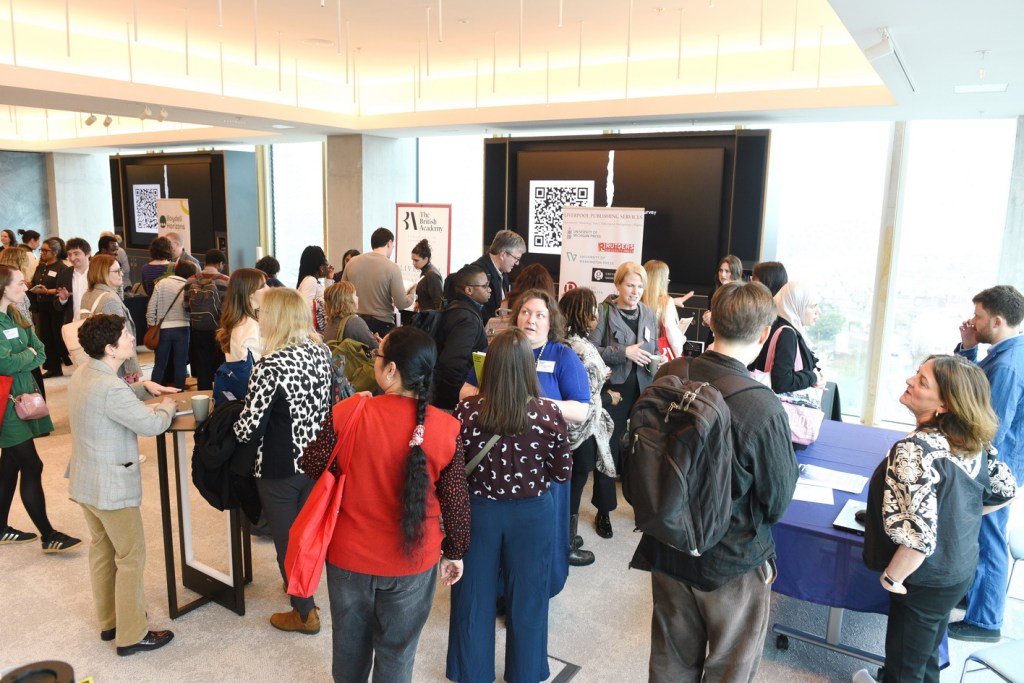
The BPC program—consisting of three parallel sessions and a closing plenary—scaffolded a more general communion between over one hundred delegates. As happens with events of this kind, the best moments are incidental, rather than scheduled. We shared our research with peers and with editors (that is, with people who are not our supervisor). In this way, informal conversation sparkled. Smaller bubbles formed and reformed throughout the day, meaning that the event itself approached the spontaneous effervescence in which brilliant and unforeseen combinations emerge. Future events could give more space to this emergent fizzy property by thinning out the program and allowing delegates to mix more freely in semi-structured networking sessions. Having said that, the venue offered plenty of space in which conversations could foam over from the timetable.
As the focus of the conference was book publishing, the most productive interplay happened at the Publishers’ Fair. Here, ECRs could meet the people at the other end of editorial inboxes. With thanks, in part, to cooperation with the ALPSP Redux conference, the Fair gathered representatives from seventeen academic presses, including five US publishers. In this space, ECRs could measure the character of each press and imagine their work typeset, bound, and—as a published book—laid on branded tablecloths.
The BPC panels covered all aspects of academic publishing, from manuscript to market, which, in 2026, means the creation of a re-flowable digital file as much as it means the binding of a sturdy codex. Jon Davies (University of Georgia Press) gave a concise overview of the entire process (answering the implied question: why does it all take so long?). In other rooms, we heard from ECRs who have completed monographs, and from editors who no longer count the number of works they have shepherded into published form.
Starting Your Academic Publishing Journey, addressed the experiences of three ECRs and their various journeys to publication. Dr Lauren Nixon gave us her thoughts on turning a thesis into a monograph, including the importance of stepping back from your project to give yourself the space to consider what you really want your first published book to look like. She also advised the audience to pick their press wisely, given that different academic publishing houses will have different strengths and that smaller outfits may offer a different level of support compared to their more commercial counterparts.
Throughout this session, we were invited to consider what our own academic identities might be, and how we might go about constructing these for ourselves through the work we publish. Dr Nico Brando offered an equally insightful talk on his experiences of publishing with the British Academy. He discussed both longform and shorter-form publication options for those wanting to consider less traditional routes to publication. He also offered advice on building a public profile as an academic, attending and organising events to build both an in-person and online following as part of a broader strategy of self-marketing.
Dr Chrissi McCarthy, the final speaker on the panel, also offered a passionate insight into her non-traditional path into Higher Education research and learning. She discussed the importance of publishing work in a way that suits the individual rather than following conventional routes to a standard scholarly monograph. She also voiced the need for thinking critically about which publisher to choose as an Early Career Researcher, encouraging delegates to pay particular attention to their backlist authors, and what opportunities they might offer in terms of Open Access publishing.
Following this, a Q&A session, Ask the Publishers, offered valuable insight into the practicalities of monograph publishing, and covered the editorial process, contracts, rights, production timelines, and how to cultivate positive relationships with editors. The session was structured as an informal discussion between Jacqueline Norton from Oxford University Press, Alison Welsby from Liverpool University Press, and Geetha Nair from The British Academy. It was useful to see the extent to which each panellist brought a wealth of information to the table, and bringing together industry experts in conversation with one another in this way provided grounded and pragmatic advice for ECRs wishing to take their first steps towards publication. This included how best to approach the challenge of reshaping a thesis into a form fit for a book (both scholarly and trade-focussed), as well as the different considerations to make when considering Open Access options, from Green and Gold, to Diamond and Hybrid.
Jacqueline Norton was able to provide insight into the editorial processes at larger-scale, more commercial publishers, whilst Alison Welsby and Geetha Nair gave insights into the degree of editorial support available to researchers who choose to publish with smaller-scale, mission-driven operators.
A session on Publishing in Other Formats offered an insightful divergence from traditional book publishing, and provided delegates with a crucial insight into the journals and digital publication processes, from article-writing and editorial guidance, to the creation of special collections and alternative publishing formats. Professor Claire Taylor offered generous insights into the submission process from a journals perspective, giving delegates the opportunity to see the steps involved beyond author submission, including the article selection and peer review process. She took the audience through the key points of differentiation between book and journal publishing, and the requirements from an editorial perspective in terms of content, structure and approach.
As Head of Publishing at Edinburgh University Press, Sarah McDonald provided an insight into her role at the Press, and the different publication formats on offer to researchers. She gave valuable advice on structuring an article, and the things to consider when looking to maximise Search Engine Optimisation (SEO) in discoverability and driving citations, and the process of finding the right journal for your work.
Lastly, Allison Levy from Brown University Digital Publications offered a fresh perspective on the digital publishing front. She showcased Brown’s digital-first route to publication as a content platform with complex multimedia sharing options which can support photographic and video-based material, alongside text, audio, and interactive maps and resources.
The final session of the day, Critical Conversations in Academic Publishing, was a resounding send off for what had been a thought-provoking and insightful day. With Professor Charles Forsdick as session Chair, Dr Philippa Grand from LSE Press, Christie Henry from Princeton University Press, and Anthony Cond from Liverpool University Press discussed the non-linear decline of the academic monograph and the challenges and opportunities this might bring for ECRs working in humanities and social sciences.
Echoing earlier papers, the panel also emphasised that the skills involved in writing for publication (with either specialist or generalist readership) are very different from that of writing a thesis, and that published material is a valuable tool for self-promotion and career development. This session also touched on the revival of institutional publishing, as an indicator of the dissatisfaction towards the large corporate models of the ‘Big Five’ publishers. Part and parcel of this was also noted to be due to the growth of the ‘Open’ (OA) publishing agenda, the rise of new digital publishing technologies, and the changing role of libraries in the Higher Education landscape. The speakers also provided a pragmatic counterpoint which acknowledged the challenges of institutional publishing away from more corporate models, asking questions of sustainability in terms of finances, as well as, by extension, how viable their OA publishing models may be in challenging economic times. They mentioned the fact that many libraries in this context are walking away from large corporate deals in the UK and elsewhere, and brought in the inevitable discussions around AI, generative LLMs, and copyright infringements. The importance of protecting the rights of authors and the integrity of the publishing ecosystem were high on the agenda, with much interest from the room directed towards the future of policymaking in shaping the trajectory of scholarship and how we might access and consume it. Delegates emerged from that session, and indeed the event more broadly, with an important takeaway: where and how you choose to publish is not only a scholarly choice, but it is also, perhaps more crucially, a political act.
About the British Academy Early Career Research Network: The Early Career Researcher Network is an inclusive, researcher-led membership body accessible to all UK-based early career researchers (ECRs) working in the humanities and social sciences – regardless of their funding source or background.
About the British Academy: The British Academy is the UK’s national academy for the humanities and social sciences. We mobilise these disciplines to understand the world and shape a brighter future. We invest in researchers and projects across the UK and overseas, engage the public with fresh thinking and debates, and bring together scholars, government, business and civil society to influence policy for the benefit of everyone
About Liverpool University Press: Liverpool University Press (LUP) has a distinguished history of publishing exceptional research since 1899. LUP publishes around 200 books a year, 50 journals, and more than a dozen digital collections. It is also the home of Liverpool Distribution Services and Liverpool Subscription Services, working on behalf of a number of university presses, foundations and non-profits to support the dissemination of scholarly research.

Follow us for more updates
Sign up to our mailing list
Follow us on social media
www.liverpooluniversitypress.co.uk

