
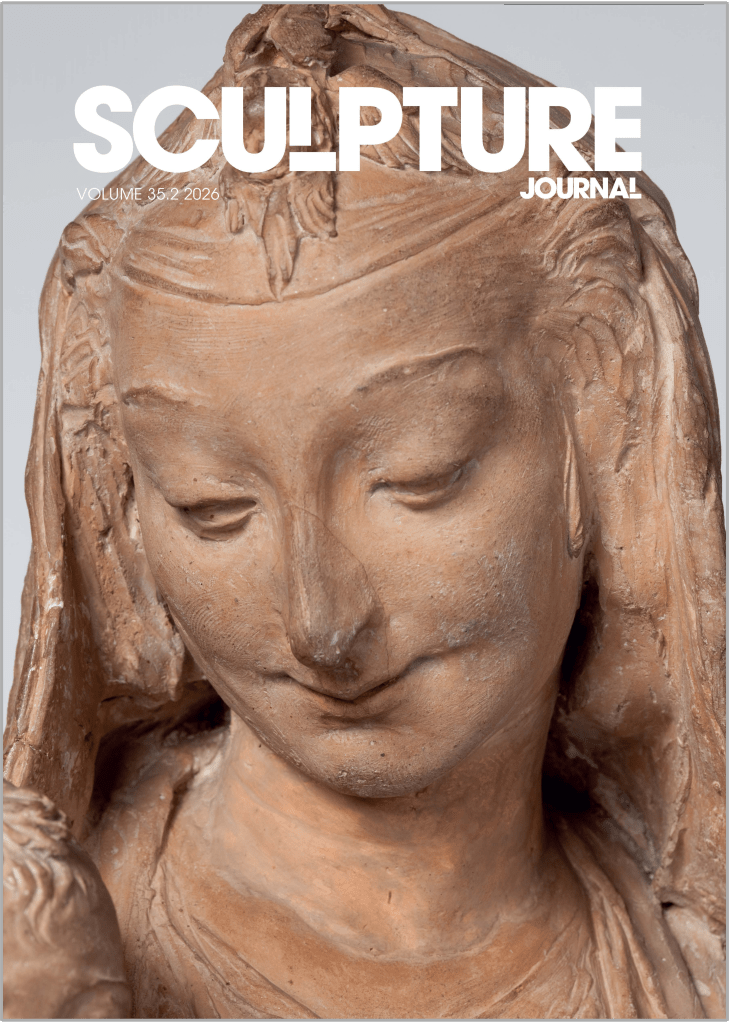
The editors of Sculpture Journal have selected the following paper as the Featured Article in Sculpture Journal 35.2, the first in a new series highlighting important new scholarship published in the journal.
The Virgin with the Laughing Child: technical and art-historical analyses of an enigmatic fifteenth-century terracotta sculpture by Charlotte Hubbard, Rachel Boyd, Lucia Burgio, Laura Chase, Adriana Francescutto Miró, Anne Bouquillon and Marc Bormand.
This article will be Free to Read for a limited time.
We invited co-author Charlotte Hubbard to introduce the article and highlight its importance:
The delightful terracotta sculpture of the Virgin with the Laughing Child has been in the collection of the Victoria and Albert Museum (V&A) since 1858, its previous history is unclear. Curiosity about the sculpture’s background, its original context and appearance, and the technique of manufacture, was the stimulus for an interdisciplinary study undertaken by curators, conservators and scientists. The aim was to gather together information from a variety of perspectives to aid the consideration of these points. The study has been revealing on several counts.
Archival, object and literature study, as well as visits and dialogues with colleagues in other institutions, made significant contributions to our findings, along with the important results from a variety of analytical methods – visual, optical and material – undertaken within the V&A and elsewhere. The results of the project, reported in the Sculpture Journal article, are the fruit of remarkable openness, generosity of spirit and collegiality between colleagues.
Given our lack of documentation prior to the sculpture’s acquisition in 1858, it was important to review again the archival material held at the V&A and in the National Archives, and possible links with an auction house in Paris were investigated. Since its purchase, authorship of the sculpture has been remarkably difficult to establish despite the attention of numerous scholars over the years. As part of this project, we re-evaluated the case for its attribution, looking closely at the principal candidates who have been proposed over the last one hundred and fifty years. Visual analysis was bolstered by the opportunity to inspect several works in the collection of the Musée de Louvre, in discussion with specialists there. Optical analysis and computed tomography scanning informed the understanding of how the sculpture was made, with the latter technique highlighting added material that alters the sculpture’s current appearance significantly, the relevance of which is discussed. It supported consideration of the iconography, elements of which are enigmatic, and also of the original function and context of the sculpture.
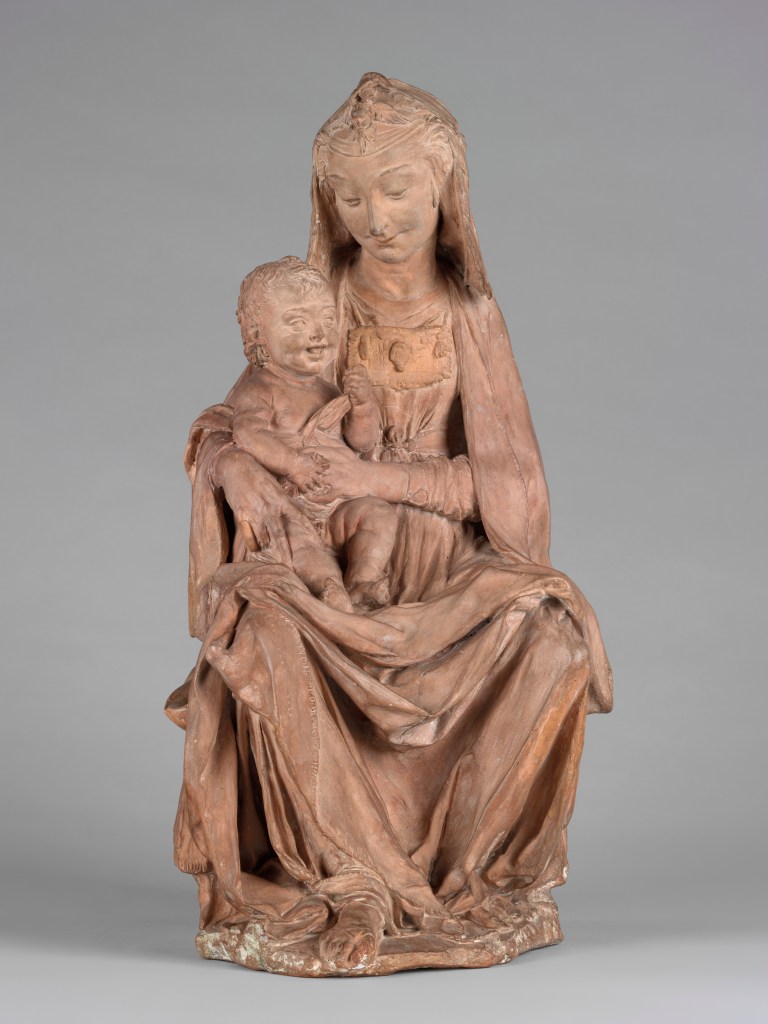
Probably Antonio Rossellino, The Virgin with the Laughing Child, 1460-75, terracotta, 49 x 27 x 24.5 cm. London, Victoria and Albert Museum, V&A 4495-1858. © Victoria and Albert Museum, London
The team at the Centre for Research and Restoration of the Museums of France (C2RMF) has been working on the analysis of Italian terracotta sculpture for over twenty years. Their database holds the results of analysis undertaken on homogeneous powder samples drilled from the sculptures and provided a crucial resource for the study, allowing comparison of samples from the V&A and aiding interpretation of results. In addition, the project team were able to take samples for viewing as cross-sections. This meant that petrography and elemental mapping could be used at C2RMF to establish individual components in the clay. To enhance the study, three further Italian Renaissance sculptures in the V&A’s collection were sampled in the same way, for comparison. The results, complemented by careful examination of the broader context of terracotta production in the Florentine Renaissance, provide us with new information that changes our understanding of these sculptors’ materials and techniques.
The outcomes of our project demonstrate the benefits of collaborative research undertaken by a team assembled from complementary fields, enriched by our individual perspectives and shaped by our collective exchange.
If you are based at a university or research institution, please consider recommending a journal subscription to Sculpture Journal to your librarian. Institutional subscriptions provide full online access to the complete archive—nearly 30 years of scholarship dating back to 1997—and support the ongoing publication of this vital resource.
Also of interest: The 2026 Free Issues: Read a free issue of each journal.

Follow us for more updates


Pingback: Sculpture Journal launches inaugural Essay Prize for early career researchers | Liverpool University Press Blog