
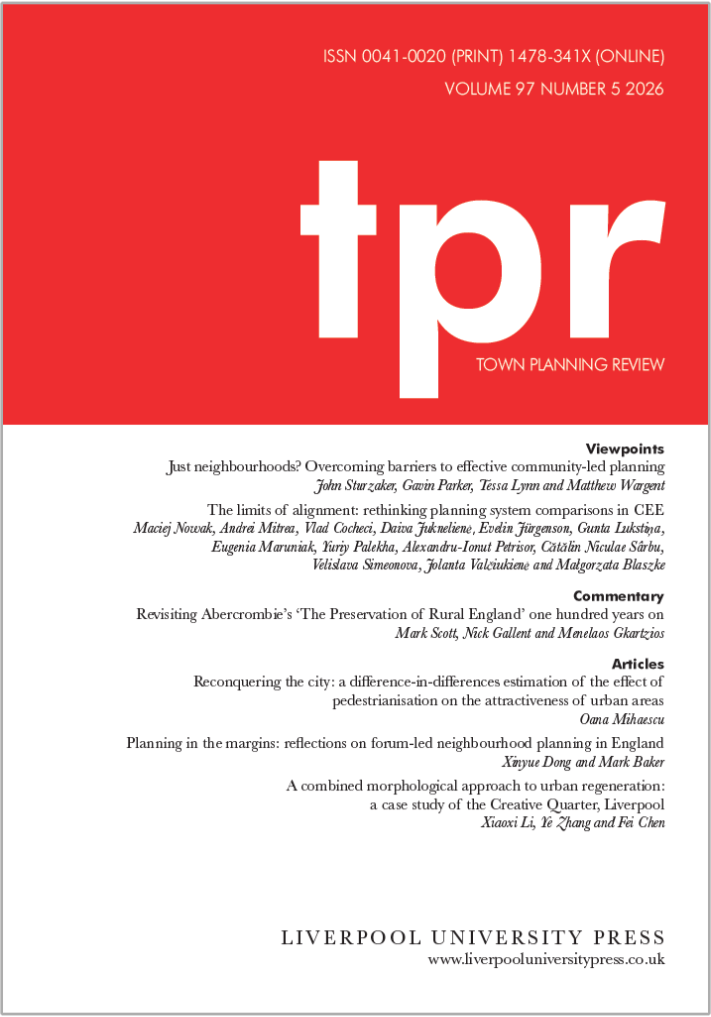
The editors of Town Planning Review (TPR) have selected the following paper as the Featured Article in TPR 97.5.
Revisiting Abercrombie’s ‘The Preservation of Rural England’ one hundred years on, by Mark Scott, Nick Gallent and Menelaos Gkartzios.
This article will be Free to Read for a limited time. To accompany it, we have also made Sir Patrick Abercrombie’s original article, ‘The Preservation of Rural England’ (1926), free to read, allowing readers to explore both the landmark text and this new centenary reassessment side by side.
When asked to describe the article and highlight its importance, author Mark Scott stated the following:
As the world’s oldest planning journal, Town Planning Review has an unrivalled back catalogue of articles which chart the evolution of planning thought over the last century. This legacy provides an invaluable resource for researchers and practitioners in tracing how ideas can challenge or disrupt established ways of working or how pioneering thinkers can establish influential and long-lived concepts, frameworks or new practice norms. In this context, we revisited Sir Patrick Abercrombie’s ‘The Preservation of Rural England’ (1926) to mark the centenary of its publication. In doing so, we hope to reflect on the significance of Abercrombie’s ideas while contributing to contemporary rural planning debates.
Sir Patrick Abercrombie (1879-1957) was a pioneer of town and country planning and a hugely influential voice in British planning in the first half of the twentieth century. His ideas and work are often associated with the rebuilding of post-war London; however, Abercrombie’s work regarding rural planning proved equally influential and set the tone for rural planning policy and practice from the postwar era to the present day. While Abercrombie’s work has often been interpreted as espousing a narrow rural preservationist agenda, we highlight that his work was not simply a demand for rural places to be left undisturbed from development but instead focused on preserving a sense of rural character. This led to a recognition that rural places are highly differentiated in terms of landscape context and development pressures, and therefore policies should be tailored to local specifics underpinned by specialist rural planning skills. Rather than a narrow agenda (that was applied in practice), Abercrombie’s 1926 article calls for innovative actions, such as the establishment of national parks, public or charitable ownership of critical land resources, the prevention of urban sprawl, nature protection, a range of approaches for enhancing accessibility to the countryside, heritage protection, and sensitive rural design to mitigate the impacts of development.
Abercombie’s prescription for rural planning is firmly rooted in a detailed analysis of the condition of rural England. These key drivers of rural change are strikingly familiar for contemporary readers, illustrating the entrenched issues that face rural places and communities. Specifically, he identifies factors that erode the character of rural places including the growing intensification of agriculture, the impacts of decentralised urban growth and sprawl, the influence of increasing car mobility and the potential influence of the ‘colonisation’ of the countryside by urban dwellers (or counterurbanisation, as termed later in the twentieth century). From this assessment, it is evident how persistent these drivers of change have been over the last 100 years. Personal mobility, new technologies, a lifestyle preference for rural living, a growing demand for second homes, more intensive farming impacts, and the changing nature of the rural economy combine and interact to drive new demands for rural space – these point to the growing influence of consumer demands rather than its productive role that would increasingly shape rural places in the late twentieth century.
In 1926, these development challenges, and an inadequate planning response, prompted Abercrombie’s call for reinvigorated ‘rural planning’ that was distinct from the ‘town planning’ that had evolved in urban areas during the previous quarter of a century. For Abercrombie, rural planning would face a different set of challenges from its urban counterpart and would need to adapt to contrasting local realities across the urban-rural continuum – from near-urban to remoter and ‘wilder’ locations. Rural planning was distinguished from town planning by its close engagement with ‘rural affairs’ and by the acknowledgement that its success – in managing the pressures of decentralisation and in meeting in situ needs – would depend on connectivity to community and grassroots organisations working at the coalface.
While Abercrombie’s work was clearly of its time, it contains many lessons still relevant today. This includes the need to avoid policy fragmentation across the rural domain, more specialist rural planning skills and professional knowledge, collaborative action, and persuasive planning that connects local knowledge and needs to strategic imperatives. In addition to the longstanding driving forces of change outlined by Abercrombie, rural places today are faced with addressing complex global challenges – climate mitigation and adaptation, energy transitions and security, food security, nature recovery and water quality. Echoing Abercrombie, we call for greater imagination amongst planners in tackling these complex issues alongside greater resourcing and investment in specialist rural planning skills and knowledge.
Support Open Access to TPR and IDPR

LUP Open Planning is a ‘subscribe to open’ transformative OA agreement for two of our journals – Town Planning Review (TPR) and International Development Planning Review (IDPR). The initiative was first introduced in 2022 and, thanks to the support of subscribing institutions, has made approximately 270 articles across 40 journal issues freely available to readers around the world.
When the annual subscription threshold is met, the latest content becomes open access for scholars worldwide, helping to build a more inclusive global research community. Each subscription plays a vital role in reaching this goal. With the support of subscribing institutions LUP Open Planning will provide:
✔ Immediate open access to the latest content for readers everywhere
✔ No open access fees for authors
✔ Greater visibility and impact for published research
✔ Subscribers gain exclusive online access to journal archives dating back 1910
To support open access for 2027 please recommend the journals to your librarian by 31 March 2027 to help make next year’s research openly available to readers everywhere.
Also of interest: Sharing the good life: Colin Clark’s contributions to urban studies | TPR 97.1 Featured Article

Follow us for more updates

