
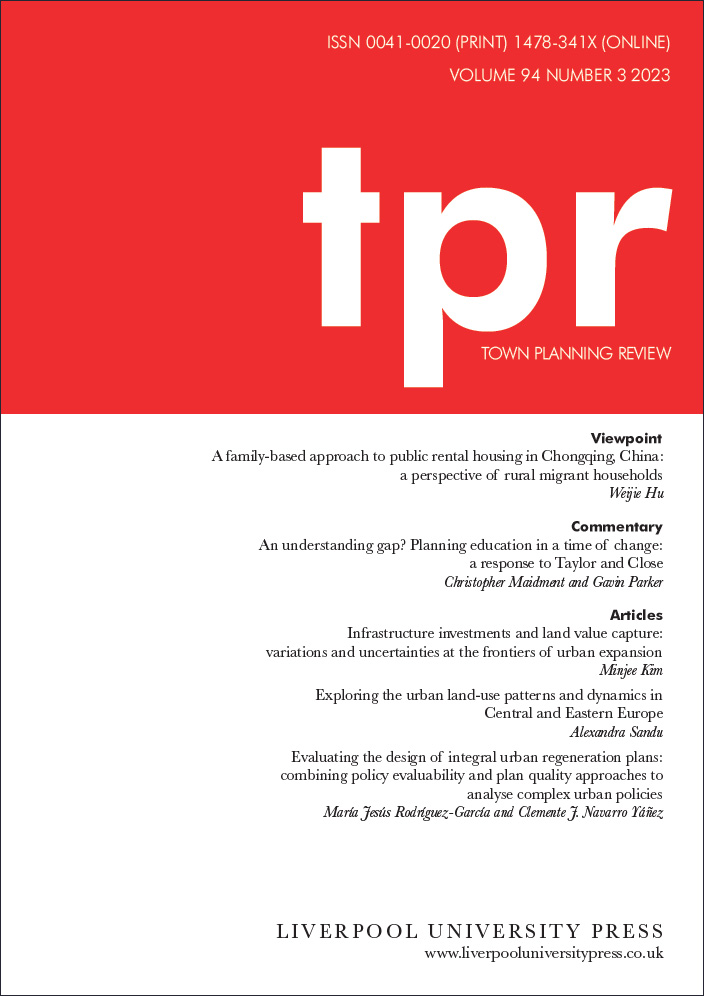
The editors of Town Planning Review (TPR) have selected the following paper as the Featured Article in TPR 94.3.
It is available to read Open Access as part of LUP Open Planning:
When asked to describe the paper and highlight its importance, the author stated the following:
When raw land is serviced by new public infrastructures, such as roadways and utilities, the land becomes suitable for more intense uses. Such a scenario presents a land value capture opportunity. The newly serviced land is worth more than raw land and therefore a portion of the land value uplift can be recouped for public benefit because it was the public sector that invested in the infrastructure. Nevertheless, it is also well-established that calculating land value uplift and the appropriate share of the public sector is neither objective nor an absolute exercise. The estimated magnitude of land value uplift, on which land value capture is grounded, can vary significantly depending on who is performing the calculations, when, and for what purpose.
The challenges associated with calculating land value uplift and the associated capture amount is exacerbated at the frontiers of urban expansion where rural land is pried open by transportation improvements. At such locations, the “highest and best use” of land is yet to be determined, which means that the value of land, dictated by its use, is uncertain. This problem is worsened because the future growth scenario for the newly serviced rural land is highly uncertain and variable. An examination of a land value capture opportunity in Citrus County, Florida, as a case, reveals considerable difficulties in anticipating the scale of land value uplift and, needless to say, the justifiable share of the public sector.
At the frontiers of urban expansion, only the richest and the most daring developers can afford to take a bet, whereas small to mid-size developers will likely have little interest in development opportunities. In other words, land value uplift will vary considerably depending on who is willing and capable of building large-scale developments at urban peripheries, at what scale, and when. When the future growth scenario is highly uncertain, relying heavily on value capture tools based on predetermined schedules, such as the UK’s Community Infrastructure Levy model, may not be the best option. The public sector may be best positioned to capture value when they combine the negotiated and non-negotiated value capture tools under high levels of uncertainty and variability.
– Minjee Kim, Assistant Professor in Urban and Regional Planning, Florida State University.

Follow us for more updates
Sign up to our mailing list
Twitter | Instagram
www.liverpooluniversitypress.co.uk

