
Trauma and Meaning in French Concentration Camp Poetry (1943-1945) by Belle Marie Joseph examines how French concentration camp prisoners sought transcendent meaning through poetry. Drawing on unpublished poems discovered in archives and family collections, as well as interviews with survivors and the relatives of prisoner-poets, the book brings to light a largely overlooked body of writing. In this blog post, Joseph reflects on the remarkable poems written secretly in Nazi concentration camps, explores what first sparked her interest in the subject, and explains how years of research into these writings shaped her book.
![Promotional image for Belle Marie Joseph's book 'Trauma and Meaning in French Concentration Camp Poetry (1943-1945)'. The book's cover sits on the left, and on the right is a review quote from Professor Sharon Marquat (Gustavus Adolphus College) reading: '[This book] will make a unique contribution to scholarship on WWII, the Nazi camps, French cultural studies, and literary studies more broadly. It will help to revive the memory of the atrocities experienced by political deportees in particular in the camps, and of the agency that internees showed in the face of trauma.' In the background, faded, is an image of a notebook taken from Ravensbruck concentration camp.](https://liverpooluniversitypress.blog/wp-content/uploads/2026/05/review-trauma-and-meaning-in-french-concentration-camp-poetry-1943-1945.png?w=1024)
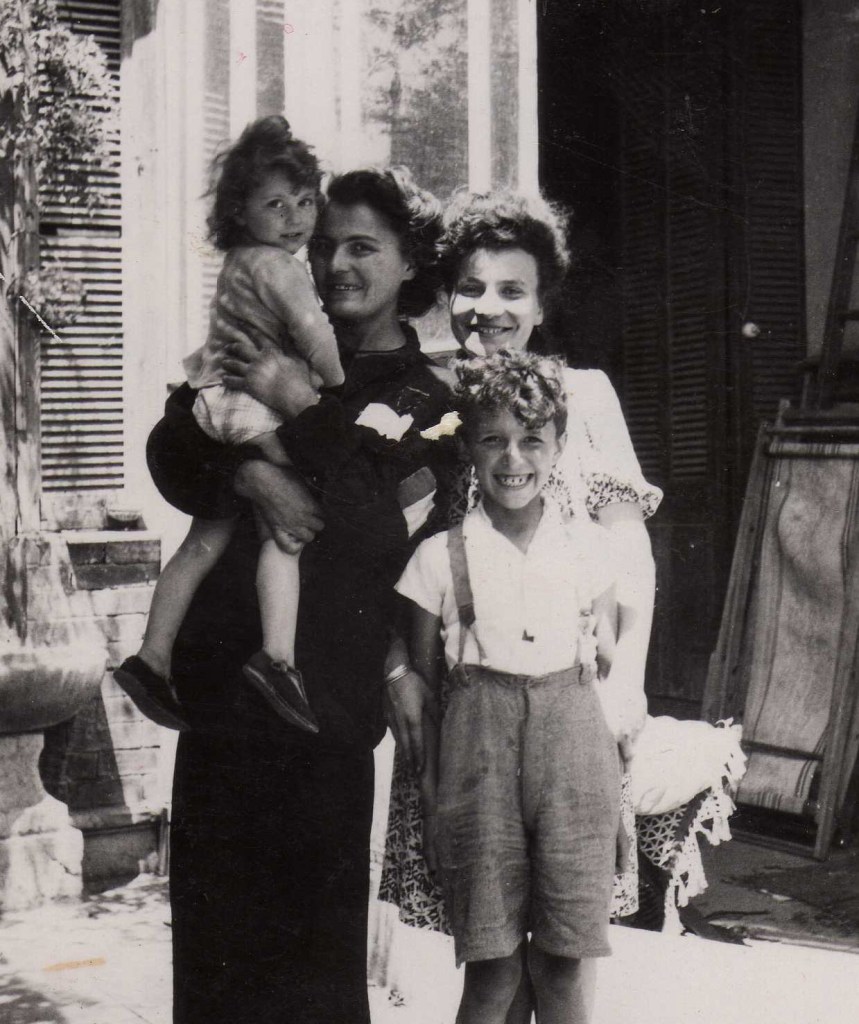
In a family’s private collection in Toulon, a hand-made notebook of poems, bound with string and inscribed in now-faded pencil, has been treasured for over 80 years. More than a family keepsake, this collection of hand-written poems originated at the site of some of the most horrific episodes of the 20th century: the Nazi concentration camps. Surprisingly hopeful at times, the poems chronicle the author’s hellish, eighteen-month ordeal in Ravensbrück, the women’s camp.
Micheline Maurel, a young schoolteacher, was arrested for her involvement in the Resistance and deported to Ravensbrück in August 1943. In the Neubrandenburg sub-camp, subjected to forced labour and to the routine terror, abuse and deprivations of camp life, Maurel, who had always revelled in literature, sought consolation in composing poems about her ordeal. Knowing how much poetry meant to her, her friend Jany Sylvaire purloined administrative forms, printed on one side only, and fashioned them into a notebook so that Maurel could put her poems down in writing. When Ravensbrück was liberated in April 1945, Maurel managed to take the notebook home with her.
It was in September 2023 that Maurel’s brother Olivier showed me the original notebook. This was more than a decade after I had first read Maurel’s poems in print, when first embarking on my research into the hundreds of French poems written by deportees in the concentration camps. Finally, I had the moving experience of reading Maurel’s verses as she had written them secretly during her traumatic captivity in Neubrandenburg.
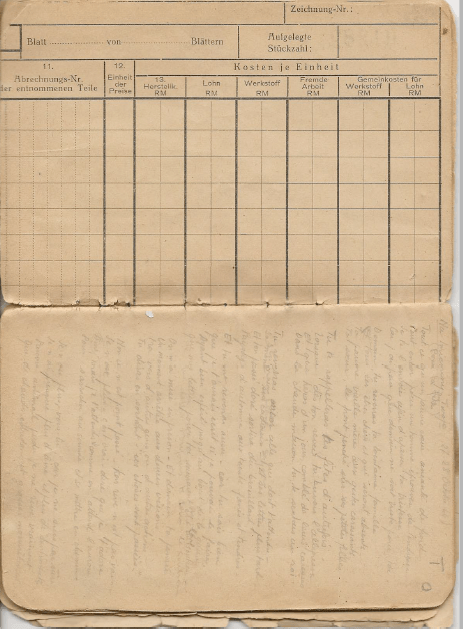
poems written by Micheline Maurel
in Ravensbrück. The poems were written
on the blank side of printed camp forms.
The poems that prisoners wrote in secret during their captivity have remained largely obscure, especially compared to world-famous survivor testimonies like Primo Levi’s If This is a Man. Poems by deportees are recited at commemorative ceremonies but otherwise reach only a small audience. This is a shame, because they repay reading a hundredfold, not simply for their historical interest, but for the poignancy and beauty which frequently characterises them, the unparallelled insights they bestow into the contemporary thoughts and outlook of camp prisoners, and the witness they give to prisoners’ attempts to find meaning in life amid their unspeakable sufferings.
Since 2012, I’ve read the published anthologies of concentration camp poems, searched for unpublished poems in archives and private collections, and met with the families of French deportees who wrote poetry in the camps. The book resulting from my research, Trauma and Meaning in French Concentration Camp Poetry (1943-1945), explores the French poetry written in the camps through a study of the works of eight individual prisoners and a group of women in Ravensbrück.
Around 160,000 people were deported from France to concentration camps between 1942 and 1944 under the German occupation. About 74,000 of these were Jewish prisoners, most of them deported to Auschwitz where the vast majority were murdered in the gas chambers; fewer than 4000 Jewish prisoners survived and returned to France after the liberation of the camps. A large proportion of the remaining 86,000 deportees were Resistants (political prisoners), although the exact percentage is unknown.
Poetry written by over 100 French camp inmates survives today in published books, family collections, and archives. The number of prisoners who wrote is impressive when it is known that they risked severe punishment merely for possessing writing materials. Even when they didn’t write their own poems, many prisoners took comfort from classic poems they had learnt by heart in their past lives, repeating poems to themselves during the long daily Appel (roll-call) or reciting poetry to their comrades in the evenings. Why was poetry so popular, and why did so many prisoners, independently of each other, compose their own poetry in the camps, in spite of the risks?
There is no one reason. Prisoners recited poems to themselves and in groups because it distracted them from their captivity and reminded them of home. They wrote their own poems because it was cathartic, giving them an outlet for their terrible sufferings. In poetry, too, they could articulate the values they wanted to hold onto and reinvoke memories of happier time. Finally, through writing poetry, camp inmates sought meaning in their traumatic experiences. A simple metaphor, an image, could afford a glimpse of consolation and hope to the suffering camp prisoner.
It is logical to expect that this poetry would be sombre and hopeless. In fact, much of this poetry, while certainly sad and sometimes dark, is also beautiful, lyrical, and life-affirming. Even when they evoke in graphic detail the violence and privations they have endured, poets find, on occasion, redemptive meaning in what they are living through. And in some poems, there is little or no reference to the horrendous conditions in the camps; the poet’s focus is on something beyond the camps, finding evidence of enduring goodness and love.
One of the last surviving French camp prisoners who had written poetry during his captivity, Dr Andre Fournier (1920-2019) wrote a letter to me in 2014 with his thoughts on why poetry mattered so much to him and to other deportees. He attributed the inspiration for poetry to two things: glimpses of beauty encountered during captivity and ‘nostalgia for free life’. Both of these, Fournier wrote, ‘elicited in us the desire (the only good that remained to us) to express our thoughts.’
A common theme in French concentration camp poetry is, indeed, homesickness. French prisoners wrote about their longing for their homes, their families, and their native regions and towns in France. They wrote poems about family celebrations and even small cherished possessions that they missed: the roses in their garden, a favourite tea-cup. Eva Golgevit, imprisoned in the notorious Block X in Auschwitz, composed a poem about her little son Jeannot back in France. ‘I will come back, my little one’, she writes. Golgevit, who survived the deportation and died in 2017 at the age of 104, was one of only a handful of French Jewish deportees who managed to write in Auschwitz.
In Mittelbau-Dora, Gabriel Blanc wrote poems about his beloved homeland of Savoie, with its vineyards and majestic mountains where he used to go climbing. Deported for his Resistance involvement in January 1944 and assigned to work in the grim underground factories where V1 and V2 rockets were manufactured, Blanc fashioned a notebook for his writings out of paper scavenged from the factory, with an aluminium cover. This little notebook of poems is now in his son’s possession.
People have asked why I chose to research the poetry written in the camps. I believe it has something to do with my formation. I grew up reading stories (fiction and non-fiction) about the Second World War and the concentration camps; Ian Serraillier’s excellent The Silver Sword was the first. Harrowing testimonies from concentration camp survivors remained etched in my mind.
I also developed a love of poetry, learnt poems off by heart, and experienced the joy of being able to recreate a poem in my mind at any time. I discovered that sometimes a single line of poetry could express better than any other genre of writing a moment of happiness, a sorrow, or a regret. It could uncover a flicker of hope in a situation that seemed totally dark. Poet Jane Hirshfield has suggested that the creative and musical language employed in poetry widens our outlook; it ‘invites us’, she writes, ‘into what lies beyond our first responses, first thoughts, first boundaries.’[1]
Poetry is, in many ways, the poor cousin of more favoured, sophisticated arts in today’s Western society: a humble, discreet artform that only needs the human mind and voice to be created and recreated. But in a sense, the very poverty of its form became its richness in the camps; the fact that it is made of such simple building blocks – words alone – made it accessible to concentration camp prisoners in the most abject deprivation. And this most humble form of artistic expression became a lifeline to many of them, enabling them, at times, to discover meaning and purpose in the midst of their sufferings.
Belle Marie Joseph
[1] Jane Hirshfield, ‘Poetry, Permeability and Healing’, American Poets (Spring-Summer 2018), https://poets.org/text/poetry-permeability-and-healing.
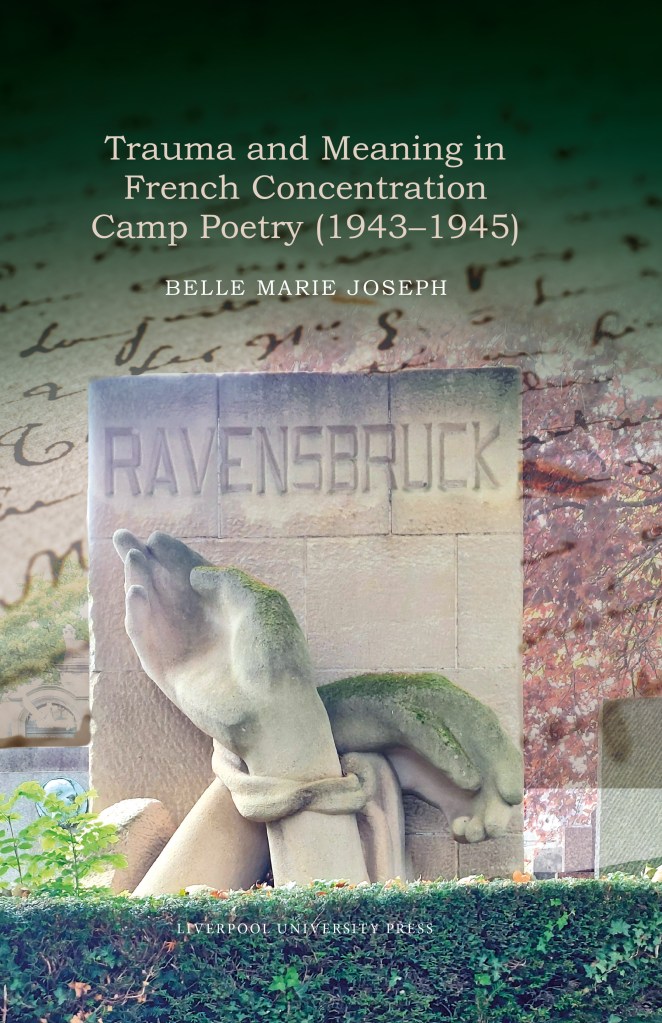
Trauma and Meaning in French Concentration Camp Poetry (1943-1945) by Belle Marie Joseph is available for up to 20% off RRP on our website.
Belle Marie Joseph has a PhD in French Studies from the Australian National University, Canberra.

Follow us for more updates
Sign up to our mailing list
Follow us on social media
www.liverpooluniversitypress.co.uk

