
Gemma Tidman’s The Emergence of Literature in Eighteenth-Century France: The Battle of the School Books has recently published in the Oxford University Studies in the Enlightenment series. This book changes our understanding of when, how, and why modern ideas of literature emerged in France. In this blog post, Gemma Tidman shares some insight into her new book in the form of a memory from when she was conducting the research in Paris.
In the spring of 2015, I found myself waiting at a drawbridge. Let me explain. I spent that year in Paris, conducting research for my book, The Emergence of Literature in Eighteenth-Century France: The Battle of the School Books. The book tells a new history of when, how, and why modern ideas of literature emerged in France, propelled – in part – by a quarrel about teaching reform and national identity.
I had a hunch that the Royal Military School, founded by Louis XV in 1751, played a part in this history. This school was an innovative institution, distinct from the traditional boys’ collèges and their Latin-centric literary curriculum. As one early document in the school’s archives put it, ‘l’éducation d’un Collège de cette espèce ne tiendroit rien des principes de l’éducation que l’on reçoit dans les Collèges ordinaires’. [1]
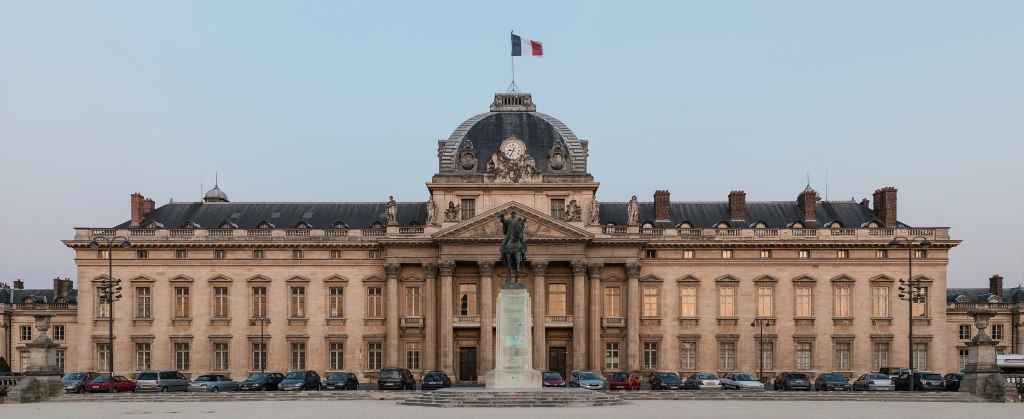
Unsurprisingly, then, the military school’s innovation has often been seen to lie in its teaching of disciplines sidelined by the collèges, such as mathematics, engineering, and the art of warfare. But this wasn’t all the school had to offer. Its programme changed over time, especially in the wake of the quarrel that emerged in 1762 about whether and how to reform collège-levelliterary teaching, following the expulsion of the Jesuits (who ran a third of France’s collèges) and the publication of Rousseau’s controversial novel about education, Émile, ou de l’éducation. I’ve called this debate the Querelle des collèges.
Scholars have elucidated some of the school’s innovations in humanities teaching: in French, history, and modern languages. [2] But what about ‘littérature’, specifically? This term became a keyword in the Querelle des collèges, often used to designate great, pleasing texts that should be taught to France’s future elite. In this debate, ‘littérature’ increasingly came to refer to a national canon, apt for a country out to reclaim power and patriotic pride in the aftermath of the Seven Years’ War. ‘Littérature’ was a word, moreover, that allowed anti-Jesuit reformers to distance themselves from the classical programme of ‘belles-lettres’ taught by the Jesuit Order. But did all this talk change anything in classrooms? Was ‘littérature’ actually taught in any public schools, pre-Revolution? Since the military school was often praised by reformers in the Querelle, I thought it was worth a closer look.
Today, the Parisian École militaire’s archives are spread across two sites: the Archives nationales, in the Marais, and the Service historique de la Défense, housed in the fourteenth-century Château de Vincennes [3] And like any self-respecting medieval fortress, the latter is accessed by a pretty excellent drawbridge. It was here, one morning in 2015, that my research got a shot in the arm.
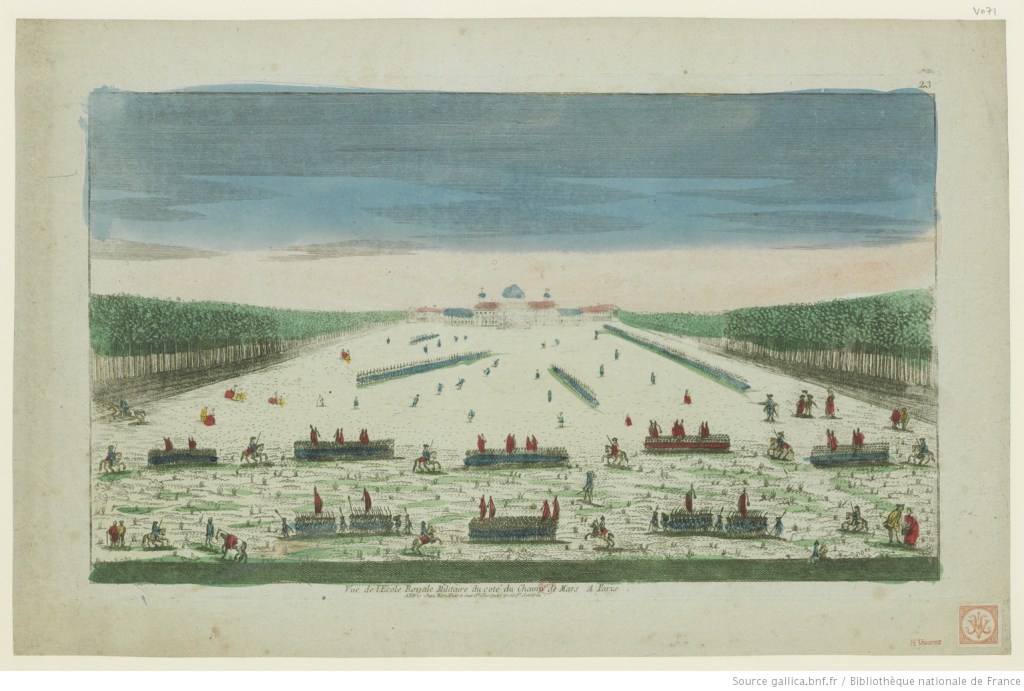
That morning, while waiting for the archives to open, one of my fellow archival in-mates – an older French gentleman – asked what I was researching. ‘L’enseignement littéraire à l’École militaire, au dix-huitième siècle’, I explained. My new friend puffed his cheeks. ‘Ho ! Vous ne trouverez pas beaucoup, à mon avis’, he said, shaking his head as he chuckled. Well, that was all it took. If there was anything in these archives, the merest hint of literature, I would find it. And, reader, I’m relieved to say there was.
There was the transformation, in 1764, of the ex-Jesuit Collège de La Flèche into a royal preparatory collège for the École militaire. This new school was to give all pupils a foundational education in the humanities. Then there were the reading books military school pupils could borrow from the library: predominantly French authors of the ‘grand siècle’ (Boileau, Corneille, Fénelon, La Bruyère, La Fontaine…), and collected biographies of the lives of great Frenchmen.
There was also the Director of Studies, Jean Dromgold, who wrote in 1774 that ‘l’enseignement de la grammaire et de la littérature françoise est un point trop important dans l’éducation de la jeune noblesse françoise, pour ne pas s’en occuper sérieusement’. [4] Teachers of ‘grammaire et littérature française’ were appointed in the early 1770s, around the time that the Collège royal, in 1773, abolished its Chaire de philosophie grecque et latine – held by the abbé Batteux from 1750 to 1773 – and replaced it with a Chaire de littérature française. Perhaps the two royal institutions influenced one another, or perhaps ‘littérature’ was simply gaining traction.
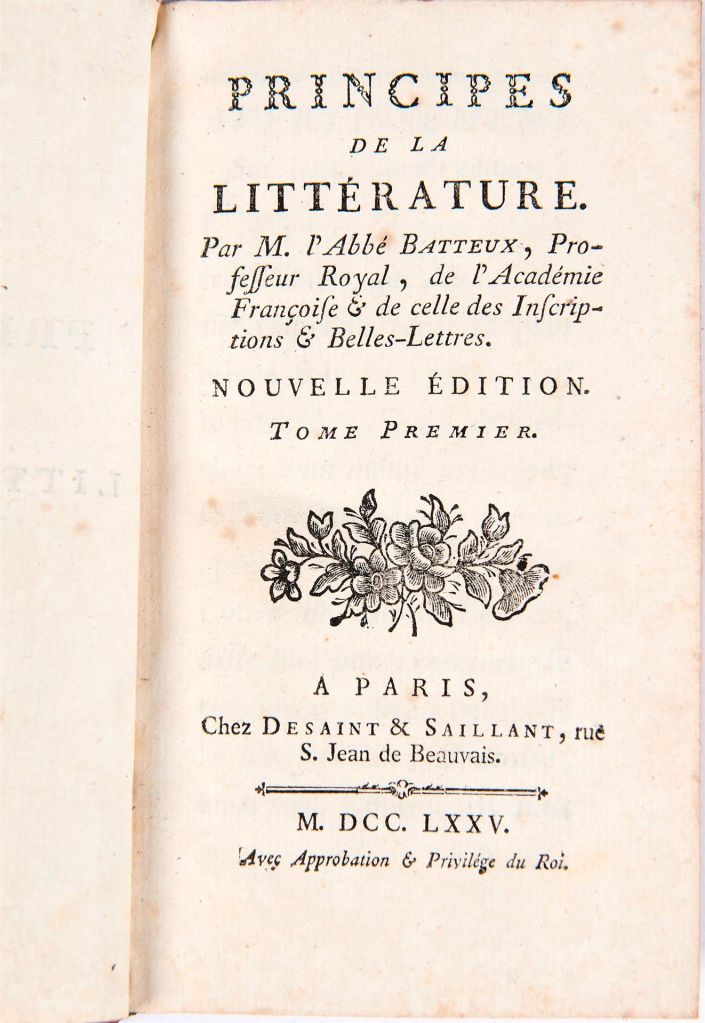
Indeed, in 1776, Batteux was commissioned to produce the teaching manual for ten new regional military schools. While this vast manual had a chequered history, it opens with an abridged version of Batteux’s own literary manual which had begun life as the Cours de belles-lettres (1747–48), before being republished as the Principes de littérature (1755). This was not the school’s only important literary teaching manual, however. In 1784, the Parisian École militaire’s then Chaire de grammaire et de littérature française, Louis Domairon, produced the Principes généraux des belles-lettres (1784–85). This textbook describes ‘littérature’ in modern terms, as a type of great, crafted text, studied within the discipline of ‘belles-lettres’. The literary extracts that Domairon comments focus on the values the military school sought to inculcate: heroism, eloquence, and patriotic duty to the king.
If the military school used ‘littérature’ as a tool to form great Frenchmen, some would say it worked. As I discuss in my book, many of the school’s alumni maintained an engagement with literature in their careers as writers, teachers, diplomats, politicians and – in the case of the school’s most famous alumnus – as Emperor of the French. In a thoroughly Bourdieusian move, when Napoleon founded the small commission charged with deciding the literary syllabus for the first lycées, he appointed to it his former teacher, Louis Domairon…who swiftly put his own textbook, the Ancien Régime military school’s literary manual, (back) on the menu.
There are probably lots of morals to this little story. About the value, and power, of a humanities education. About the unexpected people and institutions involved in the history of modern ideas of ‘littérature’. About how the briefest, chance conversation can sometimes be just what you needed. I should really thank my incredulous archival comrade for feeling chatty that morning, in 2015. Perhaps I’ll head back to the drawbridge one day to tell him what I found.
– Dr Gemma Tidman, Queen Mary, University of London
[1] ‘The education provided at a college of this kind will have nothing to do with the education one receives in a typical college’. Mémoire, dated 22 April 1750. Archives nationales, K149.1 (5.1). I discuss the archival sources further in The Emergence of Literature, pp. 67-8; p. 158, n. 5; p. 277.
[2] See, for instance, the work of Emmanuelle Chapron, in particular Livres d’école et littérature de jeunesse en France au XVIIIe siècle, Oxford University Studies in the Enlightenment (Liverpool, Liverpool University Press/Voltaire Foundation, 2021), esp. pp. 165-73, 179-85, and ‘Enseigner l’allemand par les livres: Strasbourg et la librairie pédagogique au XVIIIe siècle’, Histoire et civilisation du livre 11 (2015), p.129-48. See also Dominique Julia and Marie-Madeleine Compère, ‘Ecole militaire’, in M.-M. Compère, Les Collèges français, 16e-18e siècles, 3 vols (Paris, 1984-2002), vol.2, p.413-22; André Chervel, Histoire de l’enseignement du français du XVIIe au XXe siècle (Paris, 2006), p. 44; and the most recent history of the institution, Haroldo A. Guízar, The Ecole royale militaire: noble education, institutional innovation, and royal charity, 1750-1788 (Basingstoke, 2020).
[3] Ironically, between 1753 and 1756, Vincennes became the first physical home of the École militaire, while its permanent buildings to the west of Paris were still under construction.
[4] ‘The teaching of grammar and French literature is too important in the education of the young French nobility, for us not to take it seriously.’ Dromgold, ‘Mémoire’, dated 30 March 1774 (Archives nationales, MM669, f.125). For details of the archival sources I consulted, see chapter five of Tidman, The Emergence of Literature, p. 158, n. 5.
The emergence of literature in eighteenth-century France: The battle of the school books is part of the Oxford University Studies in the Enlightenment series, published in collaboration with the Voltaire Foundation, University of Oxford.

Follow us for more updates
Sign up to our mailing list
Twitter | Instagram
www.liverpooluniversitypress.co.uk


Pingback: A literary offensive | Voltaire Foundation