
Essay competitions in the long eighteenth century, edited by Avi Lifschitz and Martin Urmann, recently published in the Oxford University Studies in the Enlightenment Series.This book is the first to provide a preliminary, and necessarily incomplete, overview of this phenomenon across national and linguistic borders, institutional settings and media outlets.
In this blog post, Avi Lifschitz and Martin Urmann explore how these essay competitions paved the way for one of the pillars of modern academia, the blind peer review, alongside the issues of the practice, which on the surface seemed egalitarian.
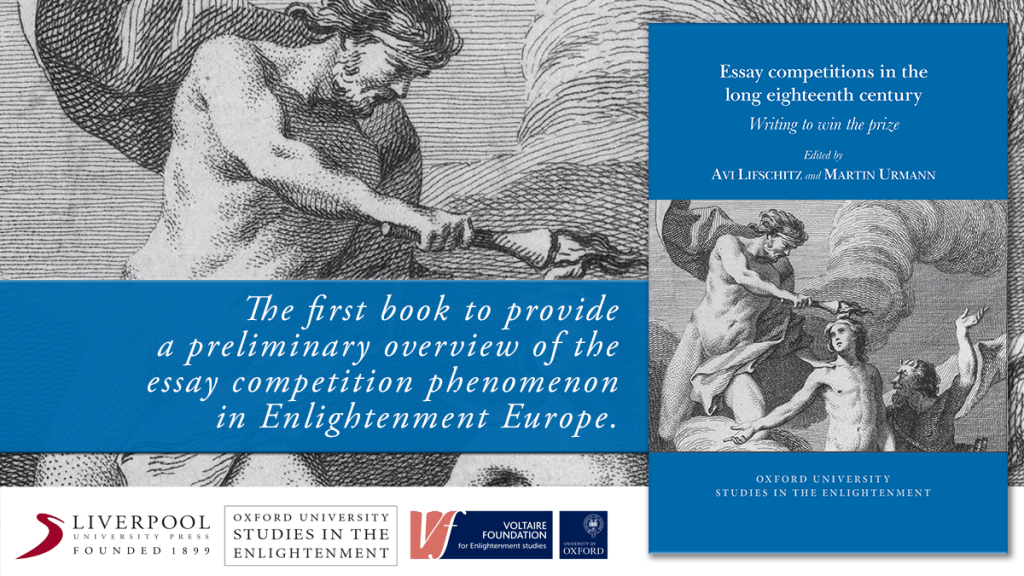
If blind peer review is a hallmark of modern academic life, its genealogy may well extend back to a fascinating practice in the Republic of Letters of the long 18th century: prize competitions run by academies, learned societies and other organisations. Members of the sponsoring body selected a topic for public perusal, often phrased as a question, and set a deadline for the submission of essays – usually a year or two after the initial announcement. The winning essay attracted the curiosity and attention of readers all over Europe; some of the laureates became literary celebrities. A brief if illustrative list of the topics would cover royal panegyric and religious apology, natural science, cultural criticism, economics, agriculture and contemporary politics. Our edited volume, Essay Competitions in the Long Eighteenth Century, traces the emergence, proliferation and shared features of such contests across Europe and some of its colonies.
The element of ‘blind’ review consisted in the anonymous submission and assessment of essays. Entries were sent in without the author’s name, headed by a prefatory quote (motto or symbolum) borrowed from classical sources. Each entry had to be accompanied by a separate envelope containing the author’s identity and the opening motto. Having assessed the anonymous essays, members of the jury would open only the envelope bearing the motto of the winning entry to identify the laureate, usually consigning all other envelopes to the fire. The anonymous submission and assessment of essays was only one characteristic of the prize contests that made them a major practice within the 18th-century public sphere. It was accompanied by openness to the general public beyond political borders and across distinctions of gender, class and religion; the exclusion of permanent members of the awarding body from participation in its competitions; the endowment of a significant prize, payable in cash or as a medal of considerable value; the advertisement of the set questions together with the relevant rules and deadlines; and the subsequent publication of the prize essays and other acclaimed entries.
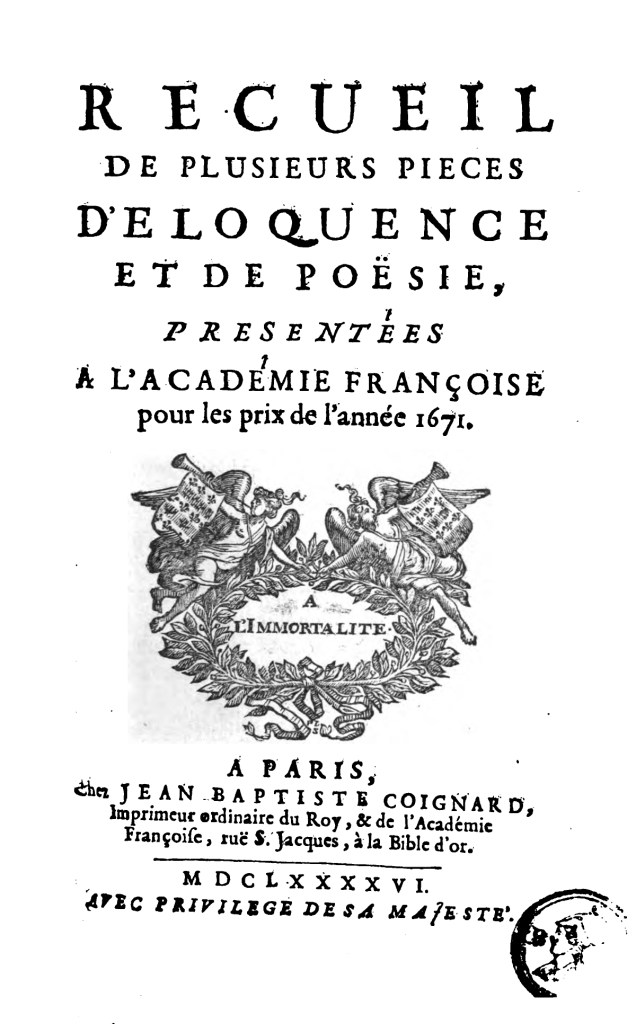
These common aspects of prize competitions in the long 18th century emerged in the regulations of the contests run by the Académie française, introduced in 1670, and new rules for competitions run by the Jeux Floraux in Toulouse (1694). Competitions were now conducted in French, by contrast with the Latin disputations at the universities. The early contests were usually limited to royal glorification and defence of the Catholic faith, but their themes became much more diverse with the establishment of provincial academies and the introduction of competitions at the Académie des Sciences in Paris (1720). Beyond the linguistic shift, Enlightenment contests differed from earlier forms of competitive literary performances due to the shift from live recitation to remote (postal) submission of entries and their silent assessment. By the late 17th century, such contests had lost their link to broader celebrations, becoming a more solemn and autonomous practice. The element of intellectual competition remained crucial for the practice – yet unlike university disputations or courtly celebrations, Enlightenment prize contests were open to the public at large.
Indeed, by the mid-18th century, prize contests had become a major forum for intellectual exchange. In France alone, academic prize contests mobilized more than 12,000 participants from 1670 to 1794. Similar competitions were run all across Europe and not only by academies. Economic and patriotic societies, as well as smaller clubs and voluntary organisations, all co-ordinated essay competitions; they were also orchestrated by learned journals and newspapers.
Anonymous participation enabled the unprecedented access of commoners, women, non-Christians and authors of humble backgrounds to the prestige associated with the prizes and hence to literary, scientific and sometimes political careers. The example of the autodidact Jean-Jacques Rousseau’s shooting to international fame almost overnight after winning the contest of the Dijon Academy for 1750 may be accompanied by the triumph of the Jewish author Moses Mendelssohn at the Berlin Academy contest for 1763 (despite the Prussian king’s veto on his membership of the same institution). Women were not only allowed to participate in prize contests but also won them, as in the cases of Madeleine de Scudéry and Antoinette Deshoulières.
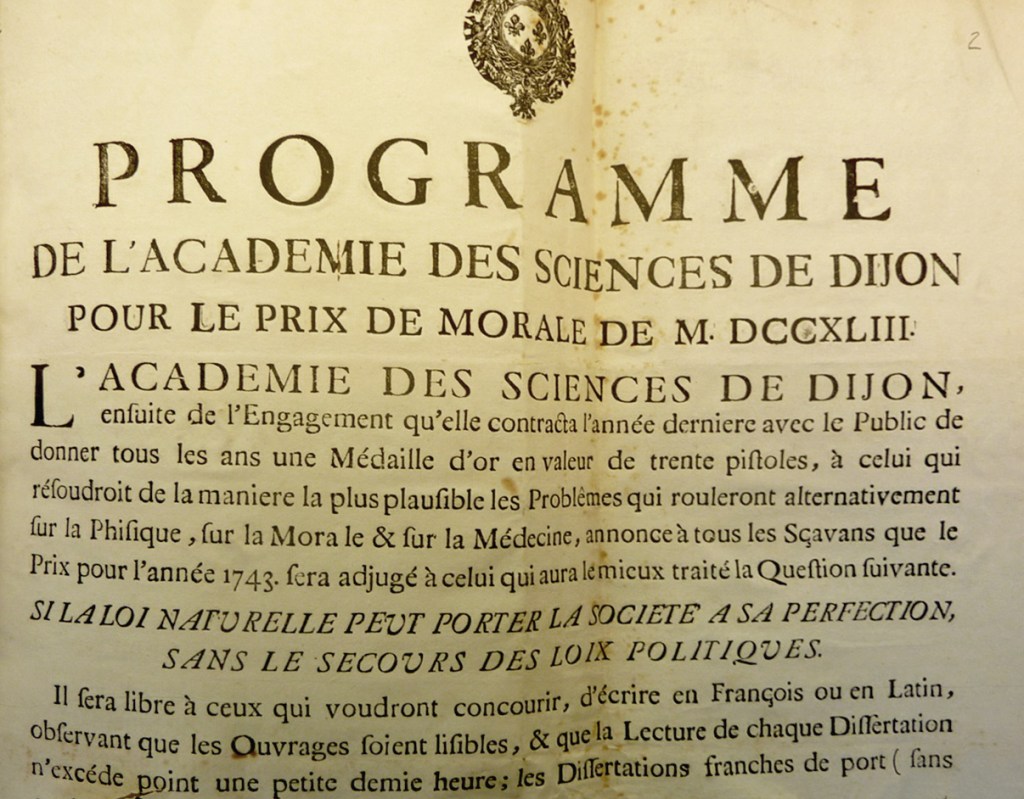
Most authors negotiated older and newer forms of argumentation to deliver what they thought juries wanted to hear (or read). It would be a mistake to treat all prize essays as expressions of their authors’ genuine opinions on the set topics: by writing to win the prize, contestants also tried to second-guess the reasons behind the selection of specific questions in particular institutions and walk the fine line between fresh innovation and respectable orthodoxy. Accordingly, we dedicate serious attention not only to the practical aspects of the contests but also to the literary genre to which they gave rise, the Enlightenment prize essay.
These contests should not, however, be seen as a fully fledged egalitarian practice. Their openness and rhetoric of impartiality contrasted with the significant cultural capital presupposed by juries: in order to compose a serious entry, authors had to draw on a wide range of classical examples and rhetorical conventions, usually the outcome of expensive or exclusive forms of education. The competitions were also part of the economy of honour, prestige and emulation that was so characteristic of early modern Europe. Prize competitions in the long 18th century can, therefore, be regarded as an innovative, participatory practice promoting intellectual excellence (or anticipating modern peer review); simultaneously, they were an ancien régime ritual dominated by social elites and often controlled by the absolutist state. In this respect as in many others, the contests epitomized the broader tensions and contradictions that characterized the European Enlightenment.
Avi Lifschitz and Martin Urmann
Avi Lifschitz is Professor of Intellectual History and Enlightenment Studies at the University of Oxford, where he is Fellow and Tutor in History at Magdalen College and Academic Programme Director of the Voltaire Foundation. He has published widely on eighteenth-century thought and its later reception.
Martin Urmann is an independent scholar who most recently worked at the CRC ‘Episteme in Motion’ (Freie Universität Berlin). His research interests include the history of rhetoric, the intellectual history of the early modern republic of letters and the poetry of decadence. He is the author of ‘L’Olympe même de nos lumières est jaloux’: die Preisfragen der französischen Akademien (1670-1794) als Medium der Wissensreflexion (Wiesbaden, 2025) and Dekadenz. Oberfläche und Tiefe in der Kunst um 1900 (Vienna and Berlin, 2016).

Follow us for more updates
Sign up to our mailing list
OSE Bluesky | LUP Bluesky | Instagram
www.liverpooluniversitypress.co.uk

