
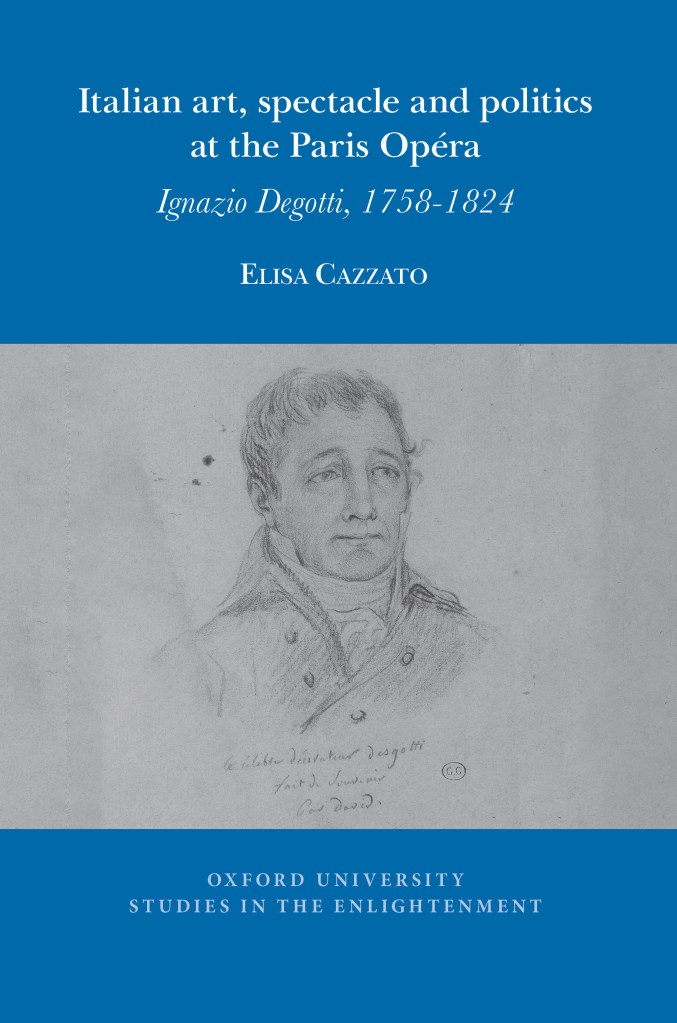
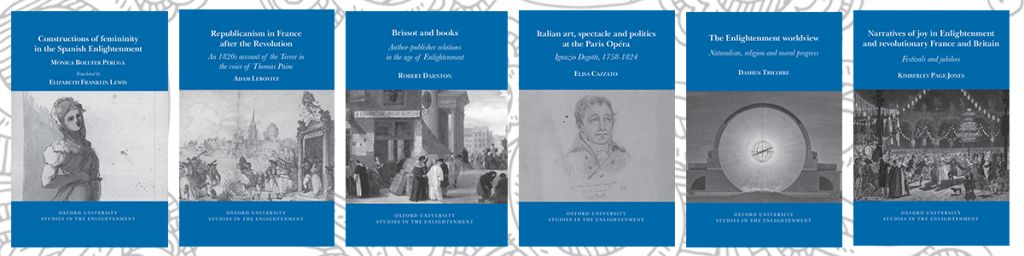
In Italian art, spectacle and politics at the Paris Opéra: Ignazio Degotti, 1758-1824, Elisa Cazzato retraces the life and career of a Turin-born artist who shaped the look of the most prestigious stage in Paris for over twenty years, yet was later almost entirely forgotten. Here she explains how reconstructing the career of a single artist can change the way we look at art, theatre and politics between the Revolution and the Napoleonic years.
How and why would scenography fit within the study of the Enlightenment? Our understanding of the period has long been shaped by its literature, its philosophy and its painting. These forms of expression, however, found in the theatre a privileged site of convergence, where text, music, dance and the visual arts were brought together before a socially diverse public. Stage design gave them a common ground, shaping the way spectators imagined history, distant lands and power itself. As this book argues, it was not a decorative accessory but a key component of Enlightenment visual culture.
This recognition came only gradually. In seventeenth-century France, the place of décoration, as stage design was then called, remained a matter of discussion within dramatic theory, while generations of Italian painter-architects, trained in perspective and stage machinery, developed an expertise admired across Europe. It was within the debates of the Enlightenment that décor became a site of intellectual engagement: the Encyclopédie redefined it as the very starting point of illusion, and Diderot’s theory of the tableau conceived the stage as a pictorial composition in which characters, action and setting became immediately legible. Who, then, could translate these ambitions into visual form? The answer lies partly with the Italian scenographers on whom Paris increasingly relied. Ignazio Degotti was one of them. In a letter of 1799 to the Opéra administration, he described the role of the stage designer as that of an architect, painter and inventor at once, versed even in botany.
Yet Degotti’s name has almost disappeared from historical narratives, not least because of the nature of his art. Eighteenth-century stage settings were built to vanish: repainted, reused or lost to fire, they survive only as traces, from preparatory sketches to administrative records. With so little tangible material, scenography has long resisted the methods of art-historical enquiry, and its practitioners have remained on the periphery of the discipline. In this sense, Degotti is not just a missing figure recomposed: he is a lens, a method and a historical problem.
Born in Turin in 1758, Degotti trained as a visual artist in the orbit of the Galliari family. In the 1780s he worked as a stage designer in Rome and Naples. In Rome he probably also met Jacques-Louis David, who would become a lasting friend and collaborator.
In 1790, as the Revolution was transforming France, Degotti moved to Paris. There he first worked for the Théâtre de Monsieur, designing several operas by Luigi Cherubini. In the revolutionary years, when questions of tyranny and the legitimacy of power animated public debate, the reception of a performance was inevitably shaped by the political contingencies of the moment, and its meaning was continually renegotiated between stage and audience. Within this process, scenery and pyrotechnic effects worked alongside music and text, amplifying their allusions and giving them tangible visual form. Spectacle thus offered a distinctive response to a shifting political terrain, one that deserves to be considered alongside the painting and printed imagery of the period.
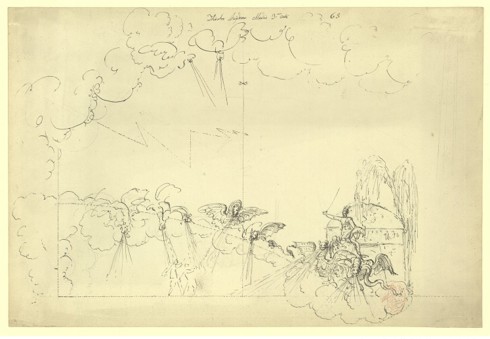
In 1795 Degotti became peintre en chef of the Opéra’s atelier de peinture, a post he held, with interruptions, for over twenty years. Under Napoleon, the Opéra became a privileged instrument for staging national myths and legitimising military campaigns. Behind these triumphs, however, the archives tell another story. Major productions were closely monitored by the authorities, and their timing was often dictated by imperial celebrations, under a pressure that frequently led to missed deadlines and exceeded budgets. The atelier itself was reorganised into a strict hierarchy of painters, with tight control over costs, materials and working rhythms. Within this system, Degotti constantly strove to defend his vision before an administration that valued discipline and economy above all.
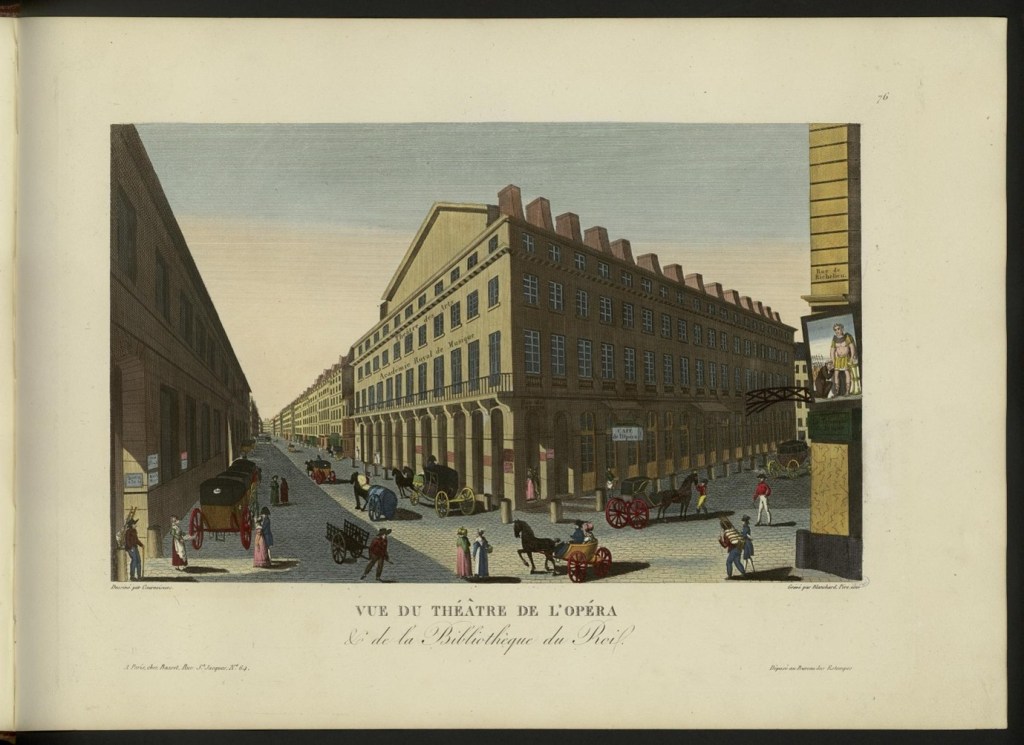
These tensions lead to a broader methodological question: how can one study an artistic practice that was never meant to endure? The approach proposed in this book lies in the reconstruction of the artist himself. Following Degotti’s trajectory makes it possible to read his scenography in relation to the theatre for which it was conceived and to the cultural and political history in which it took shape. Biography thus becomes a point of departure rather than an end in itself, opening paths of enquiry into the politics of the Opéra between the Revolution and the Empire, as well as into the artistic networks that sustained his work.
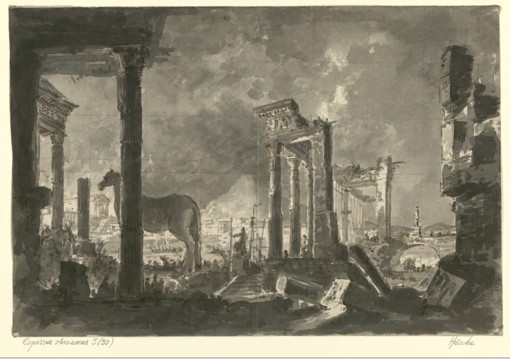
These networks extended well beyond the theatre, and none was more significant than his friendship with David. For Le Sacre de Napoléon (1807), David consulted Degotti on the perspective and scenographic setting of the composition and entrusted him with painting its background. In the finished canvas, he portrayed Degotti standing just behind his own self-portrait, among the spectators of the ceremony. Their correspondence, which continued at least until 1809, reveals a dialogue between equals. Beyond this partnership, Degotti moved within a wider circle that included Jean-Baptiste Isabey and the Greuze family, while his pupils Pierre-Luc Cicéri and Louis-Jacques-Mandé Daguerre carried his ideas into the Restoration and, in Daguerre’s case, towards the diorama and the beginnings of photography.
When Degotti died in 1824, a public auction dispersed his artistic estate, and his work largely vanished. Yet ephemerality itself carries historical weight. Seen from backstage, the Enlightenment emerges not only through its enduring works, but also through collaborative and short-lived creations experienced by large audience night after night. To return to the opening question, scenography belongs to the study of the Enlightenment as one of the places where its ideas acquired visible form. For his role in giving these ideas visible form, the man standing behind David deserves, at least, to step forward.
Elisa Cazzato
Elisa Cazzato is assistant professor and research fellow in art history at the University of Naples Federico II, where she leads the project EPHEMER-ART, on the circulation of artists and practices of ephemeral art from Italy to Europe. She holds a PhD from the University of Sydney and was a Marie Skłodowska-Curie Global Fellow at Ca’ Foscari University of Venice, in partnership with Sorbonne Université and New York University. Her research focuses on scenography, spectacle and artistic networks in the long eighteenth century.
Italian art, spectacle and politics at the Paris Opéra: Ignazio Degotti, 1758-1824 is published in the Oxford University Studies in the Enlightenment series (Liverpool University Press on behalf of the Voltaire Foundation, 2026).

Follow us for more updates
Sign up to our mailing list
OSE Bluesky | LUP Bluesky | Instagram
www.liverpooluniversitypress.co.uk

